Description
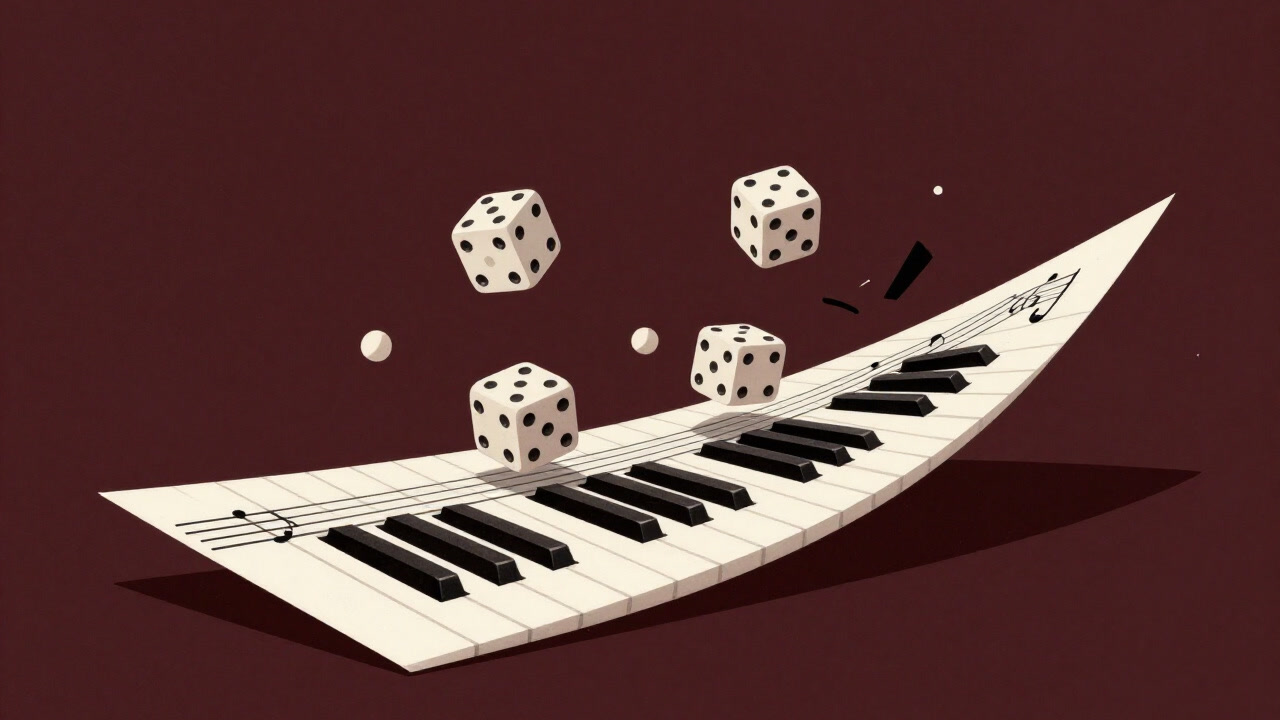
Aleatoric music is the art form where composers gamble with notes as if throwing dice, calling uncertainty a blessing. Performers entrust their fate to chance rather than a printed score, leaving audiences in suspense until the roll is revealed. Proclaimed as innovation, it paradoxically legitimizes the abdication of compositional responsibility. Blurring the lines between aesthetics and chaos, it stages a fierce tug-of-war with our need for control. The solemn embrace of disorder reveals that the audience themselves are the real experiment subjects.
Definitions
- An act of composer shirking responsibility. Entrusting note selection to chance, later blaming the ensuing chaos on others.
- An artistic violence inciting performers’ gambling addiction. All must bow to the die’s decree, invoking primal fear.
- Superficially innovative, yet merely whimsical. A stage play where accident, not intention, steals the lead.
- The avant-garde sacrifice. A mere guinea pig for so-called creativity under the guise of experimentation.
- Calculated disorder. A sorcery celebrating the chasm between page-bound bedlam and performative mayhem.
- An auditory experiment turning audiences into lab rats. A listening trap with no guaranteed outcome.
- A farce waging war on tradition under grandiose banners. True revolution lies in performers’ simmering resentment.
- Pursuing irreproducible moments while demanding apologies for each performance—cultural black humor at its finest.
- A linguistic trick of musical chance. Rhetorical victory in disguising chaos as virtue.
- A chaos apostle infiltrating the sanctum of creation. Its sanctity concealed in endlessly looping performances.
Examples
- “You’re playing without a score? Yes, whether it’s a triumph or disaster is all up to chance.”
- “Conductor? No, we’re just tossing dice here.”
- “What’s composer responsibility? The dice roll is king.”
- “Audience booing? That’s just part of the show.”
- “That’s not a mistake, it’s a courageous performer choice.”
- “The beauty of chance music is you can call it ‘no rehearsal needed.’”
- “Expecting a sweet melody? How pedestrian.”
- “Repeat it a thousand times, never the same twice—perfection.”
- “Music sacred? No, chaos is the true deity.”
- “If it fails? Then it becomes a new piece, pardon granted.”
- “Who’s in control of this performance? Great question—no one.”
- “Fate’s goddess? More like the one-faced die.”
- “Suspense is the greatest percussion effect.”
- “Fully prepared? On the contrary, unpreparedness is the aesthetic.”
- “A slip-up shameful? No, a moment of revelation.”
- “Score? Just a recipe of chaos on printed paper.”
- “Listeners and performers alike are lab rats on the same ship.”
- “This endless improv feeds the hunger within.”
- “Predictability is boring, chaos is life’s proof.”
- “Chance? For me, it’s a free vote of the soul.”
Narratives
- Before the performance, the composer secretly rolls the die, entrusting future glory and ridicule to its outcome.
- The audience listens intently, only to face a banquet of chaos none can predict.
- The score dictates not notes, but the rituals of disorder.
- Practice? Merely the mental armor preventing performers from destroying the chaos themselves.
- Success is the fleeting moment a die roll aligns with the audience’s applause.
- An accidental dissonance is revered above sacred silence.
- No conductor stands on the podium, but an agent of fate.
- Once recorded, the piece will never reproduce the same chance twice.
- Listeners’ hearts eternally crave the astonishment each new note births.
- Chaos rejects control, and control is ever mocked by chaos in their eternal duel.
- The audience’s anxiety is but a deliberately composed prelude.
- Aleatoric music is one of the rare stages where failure is welcomed.
- Each time a performer tests fortune note by note, the word ‘art’ trembles.
- Applause becomes the sole metric that decides musical worth.
- Blank spaces in the score are invitations to pray—to the chaos.
- The composer trusts the die’s roll more than the flexibility of the fingers.
- Music that hates formulas ironically binds itself to its own pattern.
- Silence is a lurking trap; the next sound holds the truth.
- Onstage pandemonium serves as an art performance testing the audience’s endurance.
- There is no finale to chance music; it is an endless trial and error.
Related Terms
Aliases
- Dice Symphony
- Luck Sonata
- Chaos Opera
- Probability Cadenza
- Rhapsody of Disorder
- Random Serenade
- Aleatoric Aria
- Note-Flipping Gamble
- Die Concerto
- Requiem of Confusion
- March of Uncertainty
- Fantasia of Collapse
- Nocturne of the Unforeseen
- Cantata of Randomness
- Symphony of Happenstance
- Impromptu Refusal Concerto
- Heresy Etude
- Nonsensical Poem
- Farce Ballet
- Refrain Without Responsibility
Synonyms
- Game of Fate
- Chance Performance
- Indeterminate Melody
- Chaos Technique
- Die Acoustics
- Tuning Gamble
- Methodical Neglect
- Discordant Play
- Risk Music
- Iconoclast Album
- Gambling Rhythm
- Dissonance Sequence
- Improvisation Addiction
- Random Field
- Anthem of Unrest
- Rhythms of Chance
- Tightrope Sound
- Speculative Opera
- Instability Canon
- Intent Nullifier Performance
Use the share button below if you liked it.
It makes me smile, when I see it.