Description
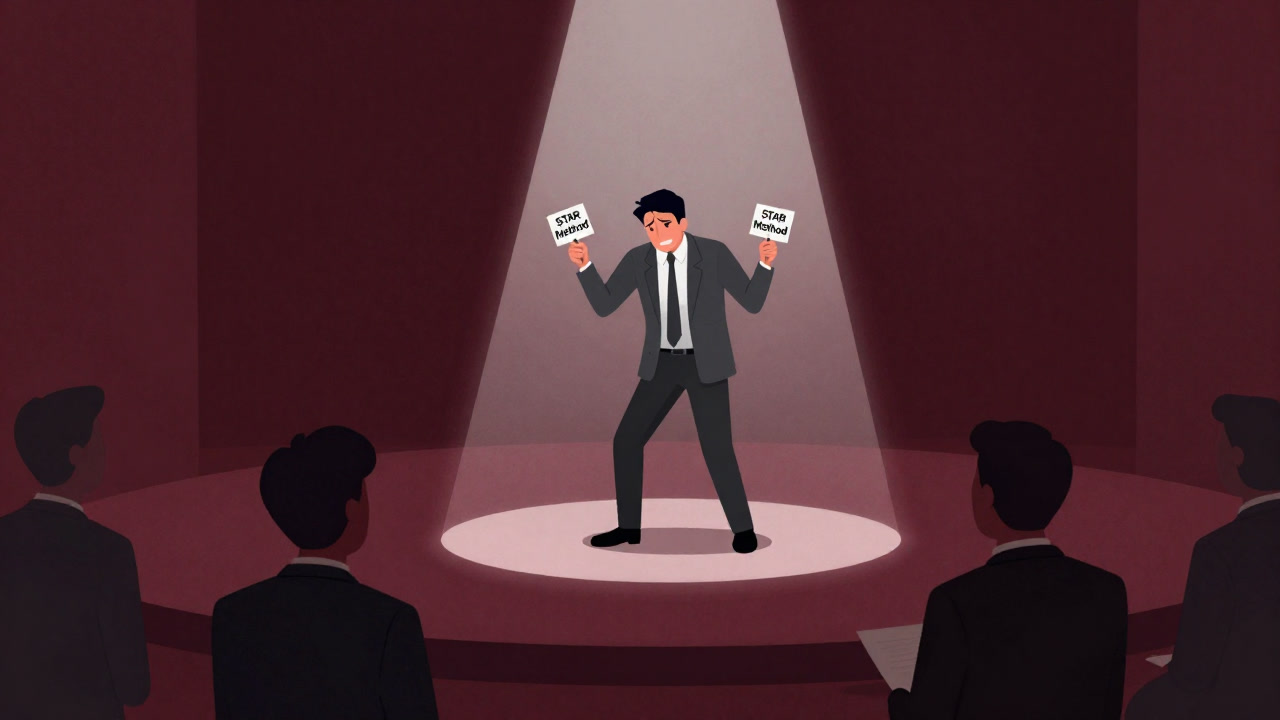
A behavioral interview is a corporate ritual that dissects a candidate’s past and offers fragments of success as immediate assets. It privileges how stories are performed over what was actually done, turning real experiences into pre-scripted narratives. Interviewers recite their manual incantations, while applicants memorize, rehearse, and optimize every anecdote. In this ceremony of form over substance, truth is habitually trimmed to fit the job description. What began as reflection ends as tailored marketing copy.
Definitions
- A ceremony that dissects a candidate’s past and reconstructs it into corporate-approved samples of success.
- A bacchanal of questions that measures the polish of one’s storytelling over the weight of one’s achievements.
- A staged production in which standardized prompts reduce real lives to interchangeable scripts.
- A recruitment farce that values the gloss of an anecdote more than its factual substance.
- A dark art that transmutes lived experiences into instantly deployable skills.
- A security feature preventing differentiation by converting memories into uniform scripts.
- A scripted play in which every query and answer is pre-approved backstage.
- A self-promotional advertisement where truth and fiction blur at the corporation’s whim.
- An alchemy that efficiently extracts fragments of memory and elevates them to disposable assets.
- A guided self-presentation ritual engineered to soothe interviewers’ anxieties.
Examples
- “Tell me about a failure. Bonus points for dramatic flair.”
- “When were you the hero of a project? Please include your costume details.”
- “Can you quantify that achievement with emotional nuance?”
- “How did you feel in that moment? Describe your inner monologue.”
- “Let’s embellish your crisis management story with positive spin.”
- “Define your strengths as three action verbs, performed live.”
- “We have a script for your leadership anecdote; kindly follow it.”
- “Do you have any failure stories? Make sure not to criticize the company.”
- “Could you narrate your triumph with background music in mind?”
- “Turn your conflict with a former boss into a self-improvement saga.”
- “How did you rationalize that decision? Don’t forget numeric justification.”
- “Stage a scene where your values are in action.”
- “In resolving team disputes, whose side were you truly on?”
- “Would you role-play that scenario for us?”
- “Pitch your proudest accomplishment in 30 seconds.”
- “An ‘impressive experience’? Impress us with its delivery.”
- “Break down the process into phases and add drama to each.”
- “Imagine a short film starring you; share its storyline.”
- “Explain your success using only corporate buzzwords.”
- “Finally, close your self-introduction as if it were a historical epic.”
Narratives
- In one firm, legend has it that interviewers wager cash on which story will earn the highest score.
- Candidates rehearse the STAR method in dedicated cafés, awaiting questions like actors awaiting cues.
- A behavioral interview is a theatrical device bridging past deeds with corporate expectations.
- During the performance, candidates must rehearse emotional peaks at precise timing intervals.
- Rumor claims that question cards are printed with incantations guaranteeing both drama and persuasion.
- Interviewers drift from query to query, while applicants linger in the wings awaiting encore requests.
- Chasing success stories eventually transforms résumés into serialized autobiographical dramas.
- Failure narratives must be lamented briefly and always conclude with a moral lesson.
- What interviewers truly seek is not your memory but the perfected narrative you present.
- Behavioral interview prep is now a mandatory training module, resembling a performance arts workshop.
- It’s not unusual to see candidates sneak peeks at manuals hidden beneath the table.
- The real goal is to ensure the audience—your interviewers—remains entertained until the final act.
- Afterward, applicants discard the wreckage of their self-analysis into coffee cups at street corners.
- The weight of experience is measured more by the heft of its delivery than its substance.
- One interview room supposedly hosted judges plotting candidates’ emotional arcs on a chart.
- Past anecdotes are endlessly recycled as scripts, with every applicant reciting the same lines.
- Interviewers reportedly thrill most when an unexpected twist punctuates the tale.
- As a result, success stories grow more grandiose, while failures become soothingly muted.
- Interview rooms are meticulously staged like theatrical sets to host the director-like panel.
- After the process, everyone wraps themselves in a neat, manual-compliant package of ‘self.’
Related Terms
Aliases
- Story Factory
- Talent Playhouse
- STAR Brainwasher
- Past Pulverizer
- Script-Oriented Tester
- Performance Directive Engine
- Question Generator
- Emotion Calibrator
- Self-PR Theater
- Success Editing Suite
- Manual Machine
- Reenactment Enforcer
- Anecdote Squeezer
- Compliance Bot
- Drama Inducer
- Script Server
- Interview Showcase
- Memory Alchemist
- Corporate Stage
- Answer Curator
Synonyms
- Performance Interview
- Scripted Screening
- Self-Advertisement
- Emotion Appeal Test
- Past Revision Session
- Script-Based Selection
- Theatrical Evaluation
- STAR Ceremony
- Story Test
- Life Mock Challenge
- Anecdote Screening
- Uniformity Audit
- Dialog Performance
- Form-First Method
- Evidence Dependence
- Micro-Script
- Interview Theater
- Success Replay
- Experience Trade
- Listenable Exam
Use the share button below if you liked it.
It makes me smile, when I see it.