Description
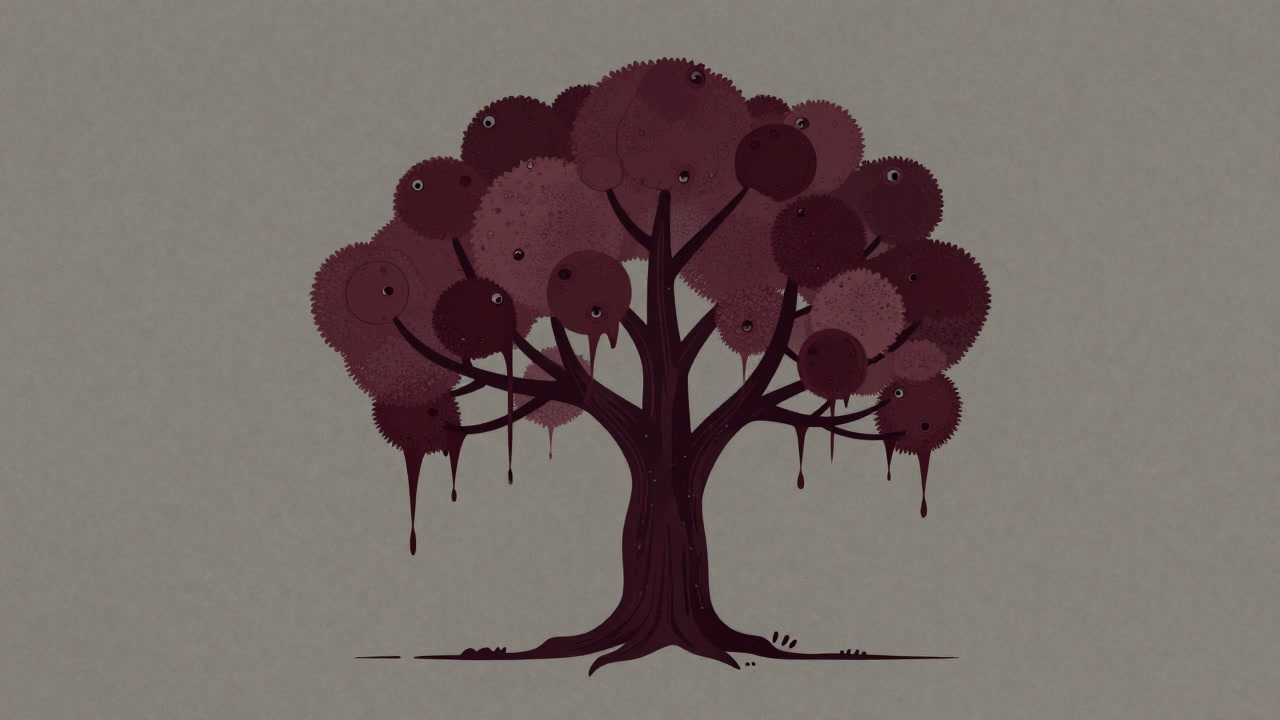
A binary tree is a tree-shaped data structure that entrusts its fate to branches splitting left and right from a root. Despite efforts to maintain balance, it endures the tragicomedy of repeated rebalancing by scholars and engineers. It enjoys the ironic “freedom” that a slight skew drastically worsens search efficiency. Through the rituals of insertion and deletion, it morphs endlessly, a logical creature of endless possibilities. In essence, it is merely a power hierarchy of tiny units called nodes, constantly asserting themselves while caring deeply about their lineage.
Definitions
- A specter of logic that claims to build order by splitting left and right, only to often shatter its own balance.
- A stage where nodes enact opaque hierarchies under the guise of parent-child relationships.
- A maze-like structure bound by the incantation of recursion, endlessly plunging into and climbing out of an abyss.
- A vessel symbolizing search efficiency, yet cursed with the cruel fate of orphaned branches when skewed.
- A data collection facing an identity crisis as it is repeatedly rewritten with each insertion and deletion.
- An embodiment of tragic irony: aspiring for complete balance but breeding bias through imperfect implementations.
- A mirror reflecting the toil of IT engineers, whose reflection is often cast away to the leaf nodes.
- The quintessential allegory comfortably residing in algorithms textbooks.
- A phantom structure that grows dynamically yet sometimes becomes a memory nightmare.
- An arena where nodes quietly compete for the throne of data branching.
Examples
- “This binary tree is skewed left again. Like life, balance is everything.”
- “Who said the tree would grow with each insertion? It just gets deeper and deeper.”
- “The recursive calls never stop… it’s like an engineer’s overtime hours.”
- “They promised binary search, but in the worst case it’s linear search. How ironic.”
- “I dream of an AVL tree, so today I adjust the nodes again.”
- “The parent commands but the children defy—feels like feudalism.”
- “The tree height is like falling into a black hole.”
- “Too many leaf nodes without proving their worth.”
- “Deleting a node always breaks the balance… it’s like a domino divorce.”
- “Optimize tree height? That’s just an engineer’s ego.”
- “‘In-order’? It’s ‘in-place’ chaos, depending on the tree.”
- “A binary tree looks a lot like a left vs right political fight.”
- “If implementation fails, not even the tree knows where its nodes are.”
- “That balancing function is as fickle as AI moods.”
- “Every rebalance gives me a heart attack.”
- “Talking about binary trees reveals one’s own instability.”
- “Non-recursive? Ultimately you use a stack. The height of hypocrisy.”
- “The history of binary trees mirrors an engineer’s suffering.”
- “A tree that talks about cycles… computers don’t lie, do they?”
- “Struggling to maintain balance like a Zen monk in training.”
Narratives
- In algorithm lectures, instructors chant “balance is vital” like a mantra when explaining binary trees.
- In reality, a slight data increase triggers an avalanche of nodes to the right.
- Those attempting non-recursive traversal experience the tragedy of never escaping the stack’s curse.
- In production, perfect binary trees are spoken of like urban legends.
- During debugging, each node misplacement unsettles the engineer’s mind.
- Insertion is both creation and destruction for the tree.
- At each rebalance, the nightmare of poor performance materializes.
- A small height difference between nodes ignites the spark that can collapse everything.
- Implementing a balanced tree forces one to either achieve enlightenment or suffer a broken spirit.
- A binary tree is the crystallization of abstract thought, a spirit drifting between lines of code.
- When data is sparse, it sleeps peacefully; when it grows, it rushes to stretch itself.
- Beneath its simple facade lurk traps that reveal a savage face at boundary conditions.
- The joy of adding leaf nodes is fleeting, immediately followed by the harsh reality of imbalance.
- No one praises the tireless effort of those who strive to maintain balance.
- Depth-first and breadth-first traversals wander like travelers choosing sunlit paths or back alleys.
- Whiteboards filled with tree diagrams reflect pure chaos as debates heat up.
- One day, an engineer abandoned tree reconstruction and started reconstructing their career.
- Binary tree workshops become dojos for engineers turned demons of balancing.
- In pursuit of fame under the name ‘AVL tree’, some have lost sight of their own branches.
- Binary trees are the cruelest mirror, reflecting an engineer’s pride and humility simultaneously.
Related Terms
Aliases
- Forked Labyrinth
- Balance Breaker
- Left-Right Captive
- Slave of Nodes
- Bias Branch
- Abyssal Tree
- Recursion Hell
- Leaf Graveyard
- Ritual of Insertion
- Illusion of Equilibrium
- Memory Nightmare
- Parent-Child Farce
- Branchlet Revolution
- Acrophobic Tree
- Algorithmic Beast
- Logic Maze
- Forgotten Tree
- Dirge of Terminals
- Infinite Spliterator
- Static Chaos
Synonyms
- Bifurcation Beast
- King of Skew
- Buried Branch
- Rebuild Roulette
- Search Mirage
- Structural Phantom
- Leaf Lament
- Depth Curse
- Parent-Child Theater
- Dynamic Despair
- Equilibrium Myth
- Discrete Stage
- Code Castaway
- Memory Trap
- Nonstop Calls
- Branch Ensemble
- Cascade of Chaos
- Terminal Loneliness
- Tragedy of Layers
- Split Insanity
Use the share button below if you liked it.
It makes me smile, when I see it.