Description
A design pattern is an ancient incantation lurking in the forest of software architecture. Developers cling to its ritualized invocation to revere the same problems again and again. Though spoken with elegant names, they often become tombstones marking labyrinthine code. Some believe applying them banishes bugs; others merely multiply them. In the end, all that remains is a facade of uniformity and wry resignation.
Definitions
- A supposedly foolproof strategy that actually blends developer sloth and fear into a single methodology.
- A magical framework that makes repeating mistakes reusable, numbing the learning curve.
- A design philosophy grand in name but hollow in substance.
- An incantation that gains gravitas on paper but balloons into binding complexity in implementation.
- A paradoxical claim of universality that calls forth exceptions with every application.
- A ritual that adorns code at the expense of the virtue known as readability.
- A pact promising design stability that secretly introduces new constraints.
- A treasure trove of innumerable choices, each capable of unleashing hell when chosen incorrectly.
- A scheme to indoctrinate junior engineers into unspeakably abhorrent coding styles.
- A beast that blocks the exit of refactoring and supplies endless reasons for accumulation.
Examples
- “Which pattern did you apply here?” “The latest Yoga Pattern – it makes bugs stretch around elegantly.”
- “Refactor? Too much work, let’s brute force it with the Decorator Pattern.”
- “Another Singleton, huh? Looks pristine, but the innards are an abysmal mess.”
- “Strategy Strategy they say, yet it always falls back to an infinite if-else loop.”
- “Singleton? Ah, the holy grail for global variable prohibitionists.”
- “Factory Method to churn out objects en masse! Guaranteed hell included.”
- “Separate view and controller? Implementation only delivers a dependency hell.”
- “You trust Adapters? It’s really just a junkyard of tangled connectors.”
- “Implemented MVC once; felt smart till the whole team got lost in the maze.”
- “Decorator Pattern? Elegant name, but it’s a blade that severs the lifeline of your code.”
- “Prototype? Cloning sounds fun until you realize god only knows what you’ll get.”
- “Observer Pattern? The ultimate tool to create a surveillance state.”
- “Command Pattern to objectify every instruction? You’re just building a resume for bugs.”
- “Strategy Pattern for strategic behavior? Each extension collapses your control flow.”
- “Flyweight? Memory efficiency? More like superficial slimming performance.”
- “Bridge Pattern? Best when the bridge collapses under load – fun times ahead.”
- “Visitor Pattern? It’s basically hurling stones from outside at your codebase.”
- “Chain of Responsibility? It loops around until nobody ever handles anything.”
- “Monostate? Everyone shares the same state and trips over each other gracefully.”
- “Facade Pattern? Obfuscation art? It’s just a thin veneer over chaos.”
Narratives
- The moment a new feature was added, the developer uttered the incantation of the design pattern. Yet the curse returned as an unforeseen exception.
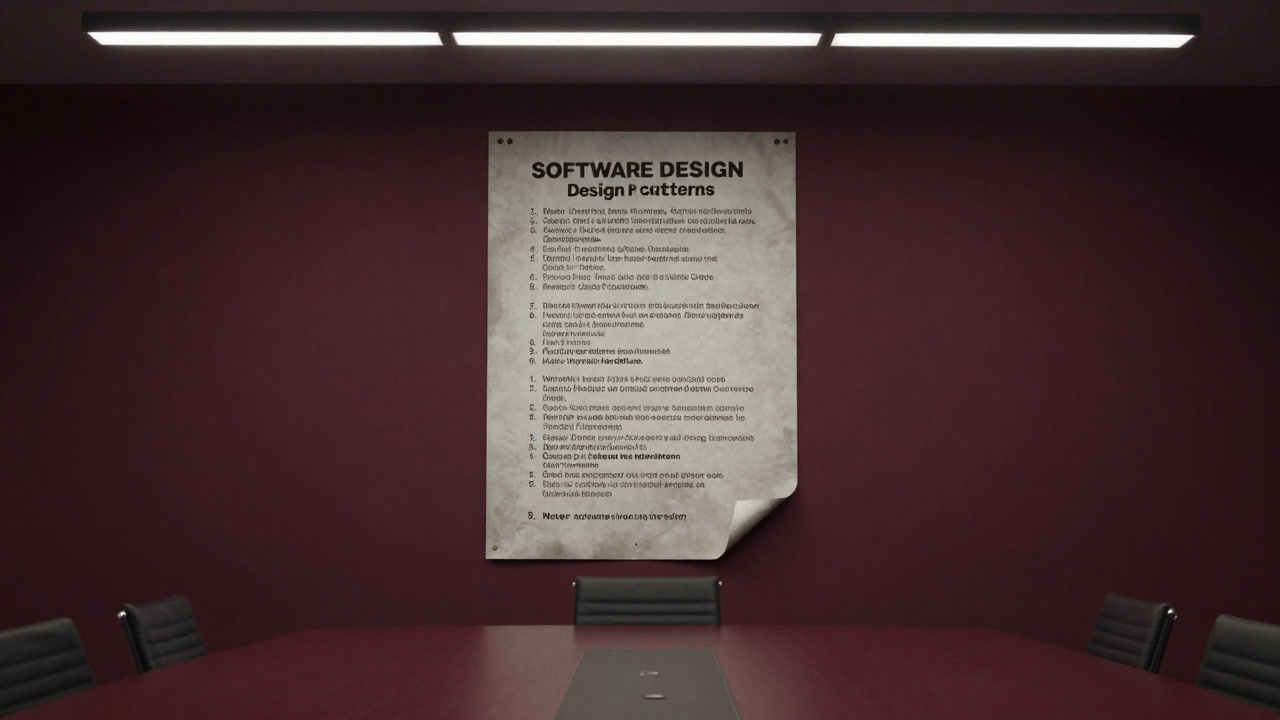
- In the conference room, a poster demanding “Obey Design Patterns” hangs alongside a mind map. No one dares to inquire its meaning.
- A reviewer scrawled ‘Singleton Overuse’ in red on the code, leaving a deep scar on the junior engineer’s psyche.
- When veterans reminisce ‘We didn’t have these fancy Factories back then,’ they speak sacred verses that spawn new faith.
- A project that applied a certain pattern, instead of progressing smoothly, arrived at a dead end by design.
- Documentation is littered with the words ‘Template Method,’ a trap that repels any reader.
- Deep within the codebase, classes lost in the labyrinth of abstraction cry out in agony.
- The project manager proclaims ‘Thanks to this pattern, reuse has improved!’ Yet nobody recalls any reuse ever occurring.
- Build logs failing CI are sprinkled with pattern names, mocking developers like devilish graffiti.
- Is modularization a holy ritual or an invitation to chaos? A clear answer never arrives.
- When writing unit tests, developers chant ‘Use an Adapter!’ yet reality remains a tangled nightmare.
- With each refactoring, the corpses of patterns accumulate within the codebase.
- Eventually, the team executed a ‘Pattern Detox,’ but no one dared touch the real source of decay.
- During pair programming, when asked ‘Is that a strategy or just an if-hell?’ the room froze in terror.
- Incorporating an external library spawned hordes of Observers, leaving logs multiplying infinitely.
- Overuse of patterns turned the code into a chaotic jazz jam of improvisation.
- When a newbie asked ‘Why do we need an Iterator?’ the senior replied with distant eyes, ‘That’s classified.’
- Self-proclaimed architects boast ‘We are pattern seekers,’ creating an atmosphere where no one disagrees.
- Proposing a pattern review just before deployment plunged the proposer into a nightmarish code review abyss.
- By the project’s end, nobody could speak of the true nature of patterns.
Related Terms
Aliases
- incantations of design
- code sigils
- ritualistic templates
- developer’s holy glyphs
- abstraction trap
- reuse mirage
- architectural alchemy
- template hell
- labyrinthine rite
- ancient design codex
- paradox seeds
- idiom altars
- void of generality
- cross-language camouflage
- curse of structure
- pattern fortress
- module maze
- dependency hell
- ritual procession
- formalist shapes
Synonyms
- ritual design
- abstraction spells
- template rites
- developer purgatory
- structural incantations
- generic illusion
- design labyrinth
- reuse hypnosis
- module yoke
- chain of dependencies
- ceremonial code
- naming mania
- interface flood
- factory feast
- persistence trickery
- skeleton specter
- observer watch
- prototype uprising
- composite theatre
- state stagnation
Use the share button below if you liked it.
It makes me smile, when I see it.