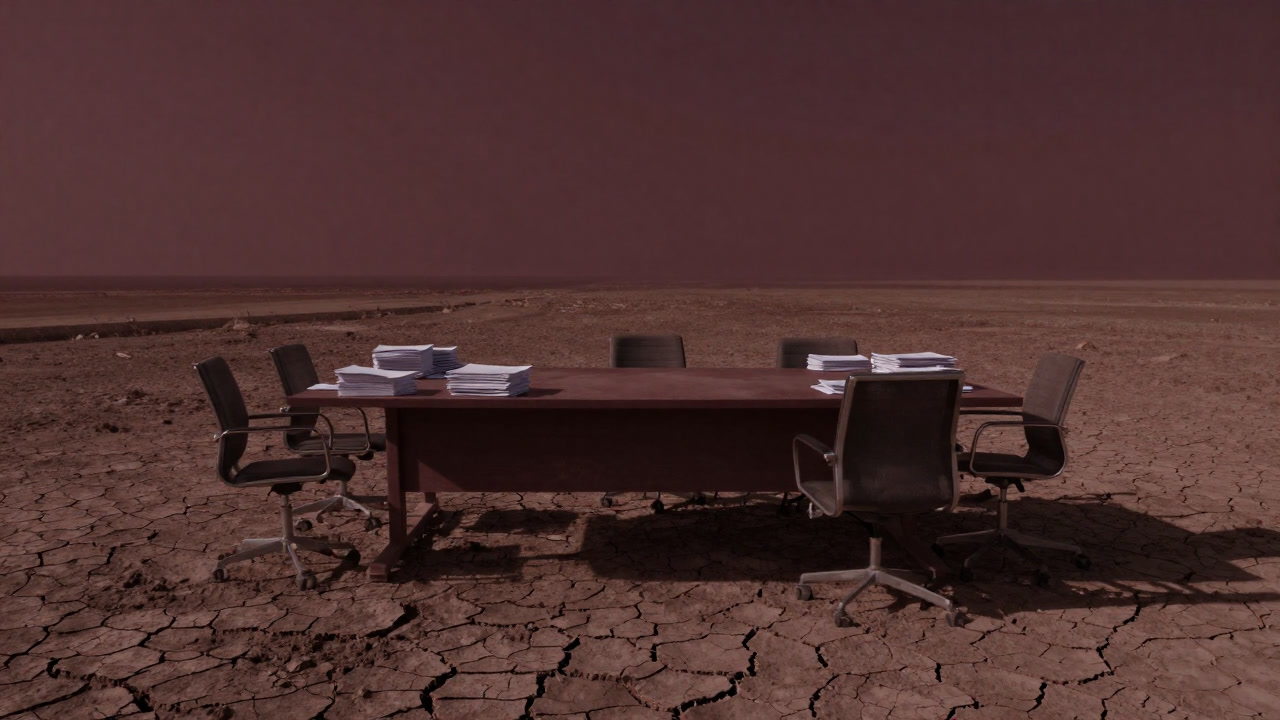
Description
Drought management is the bureaucratic art of mixing meaningless meetings with citizens’ lamentations over the absence of rain. Its primary function is to dehydrate conference rooms and eventually beg for the ‘next fiscal year budget’ as if it were a miracle cure. Practical results are secondary to the proliferation of PowerPoint slides and glossy brochures. The ultimate goal of officials is to persuade clouds with speeches, while field workers pour their hopes into leaky buckets.
Definitions
- A state performance whose main achievement is drying out the conference room.
- A magic incantation that summons budgets instead of rain.
- A breeding ground for paperwork that cultivates a false sense of security.
- A bureaucratic ritual that rejoices in convening meetings rather than reproving clouds.
- Alchemy that parallels desert monitoring with rising budget percentages.
- An administrative process that prioritizes document filing over water replenishment.
- A parched festival celebrating endless expert debates.
- A tragedy where real relief diminishes while metrics quietly increase.
- A custom that values report deadlines over citizens’ emergency pleas.
- A government-sponsored event that repurposes rain dances into budget proposals.
Examples
- “Drought management meeting is again tomorrow at 9 AM. No water will flow, but we have heaps of materials prepared.”
- “This year’s theme is ‘paperless arid administration’, apparently. Well, the papers are piled high nonetheless.”
- “Mayor, any ideas to make it rain?” “Let’s start with a PowerPoint cloud chart first.”
- “The field is cracked earth.” “But the conference room has state-of-the-art HVAC.”
- “When you talk about drought countermeasures, it’s all about the budget.” “Unfortunately, only the budget is flourishing.”
- “Rainfall decreased because of global warming.” “Then let’s increase the amount of documentation.”
- “Here are today’s meeting materials.” “Are these all budget request documents?”
- “Complaints from citizens?” “Please use the suggestion box for the responsible section.”
- “What’s the progress on securing water sources?” “I’ve filled in the dates on the progress report sheet.”
- “How’s the effectiveness measurement going?” “The results are scheduled to arrive by the next meeting.”
- “Let’s revive the waterwheel.” “First, we need approval from the preservation society and the budget, of course.”
- “Did the rain dance rally succeed?” “We had 50 participants, but no heavy rain was confirmed.”
- “Dryness advisory?” “It’s just been announced; consciousness hasn’t changed at all.”
- “This year we’ll stop desertification for sure!” “All we have are robust posters and slogans.”
- “Interagency liaison meeting—‘com-mu-ni-ca-tions lo-o-o-ng’.”
- “Drought countermeasure HQ?” “It’s a fully air-conditioned, comfortable office.”
- “What about distributing emergency relief supplies?” “The distribution schedule will be reflected in the next budget proposal.”
- “Water shortage? In other words, a budget shortage, right?”
- “It would be faster to actually dig a well.” “We can consider that under PPP (public-private partnership).”
- “Who is drought management for?” “For meeting enthusiasts and the budget execution department.”
Narratives
- Drought management is not an epic tale to halt desertification, but the daily routine of consuming time in meetings and mass-producing minutes.
- In panel discussions, not a single real cloud appears; only lofty ethical abstractions swirl about.
- In the city hall corridors, rain dance posters stand side by side with piles of classified documents.
- Officials praise graphs called ‘Target Achievement’ with dry humor mixed in.
- When the desertification prevention project is brought up in progress meetings, someone inevitably whispers, ‘Let’s start with an investigation.’
- Even if rain does not fall, the child of the budget grows robustly.
- The wishes of local residents weather away, leaving only indicators surviving in the void.
- During inspection tours, they pose smiling in front of photos of disaster sites, then move on to press conferences.
- In the arid zone field, talk of breeding tropical fish thrives more than the bare feet treading the sand.
- On the administration’s website, only rainfall charts and inquiry forms are lined up in a sterile fashion.
- The number of pages in the report is deeper than a dried-up riverbed.
- At residents’ briefings, redundant explanations continue, and citizens listen with thoroughly dry ears.
- Field engineers, covered in dust, bury themselves in stacks of paperwork through the night.
- The concept of ‘dryness’ becomes bureaucratic jargon, and no one questions its true meaning.
- What takes precedence over eco-bags is the waterproof document folder.
- At the disaster response headquarters, there are more markers on the desk than mugs.
- Expert panels speak more about ‘meeting efficiency’ than about ‘degree of dryness.’
- On Twitter, #budgetDeliberation trends more than #RainDance.
- What’s more reliable than rain radar is the meeting invitation email.
- There’s a custom to postpone report submission dates at least six months beyond citizens’ expectations.
Related Terms
Aliases
- Conference of Aridity
- Budget Rain Dance
- Paperweight Expansion Device
- Prayer Funding Supermarket
- Meeting Convention
- Cloud Persuasion Program
- Disaster Glamor Project
- Panel Stage Show
- Excuse Factory
- Desert Monitoring Circus
- Dryness Alert
- Null Indicator Machine
- Paper Mountain Industry
- Poster Worship
- Slide Incantation
- Meeting Fertilizer
- Minutes Flood
- Desertification Festival
- Cloud Ignorance Plan
- Endless Fund
Synonyms
- Aridity Therapy
- Budget Begging
- Document Desertification
- Meeting Wasteland
- Storm God Ignorance
- Bureaucratic Thirst Syndrome
- PowerPoint Sea of Clouds
- Funding Ritual
- Report Marathon
- Cloud Nullification Tactic
- Sand Concealment Strategy
- Office Camaraderie
- Lip Service Training
- Eco Hoax
- Dust Control Club
- Doc Destruction Waltz
- Null Conference
- Vaporware Lab
- Arid Marketplace
- Excuse March
Use the share button below if you liked it.
It makes me smile, when I see it.