Description
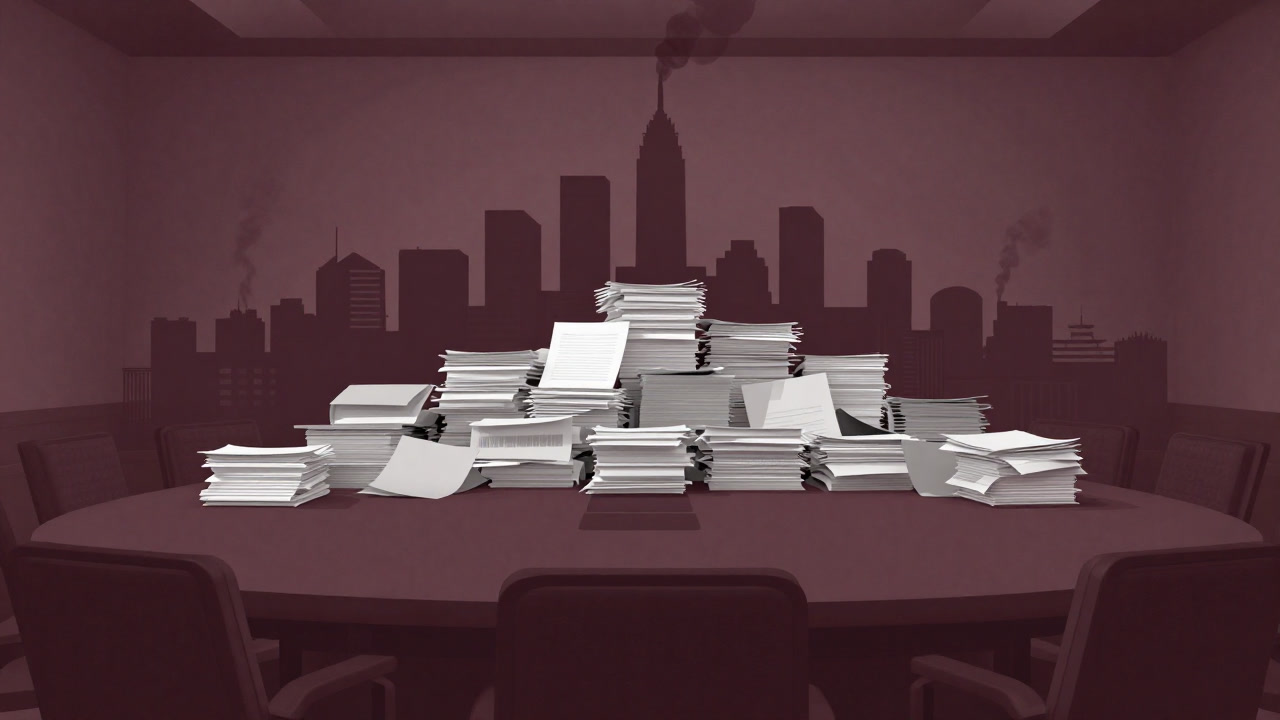
Emergency management is institutional rhetoric that claims to control chaos while cleverly deflecting responsibility. It promises safety to the public only to invoke the excuse of “unforeseen circumstances” when things go awry. The heft of planning documents grows in direct proportion to on-the-ground disorder, as meetings become grandiose rituals of futility. In emergencies, it is the announcer, not the commander, who actually waves the flag. In the end, no one truly manages the crisis, but the paperwork keeps praying for calm.
Definitions
- An institution that proclaims control of society yet skillfully shifts blame from officials to citizens.
- A bulking engine of planning documents more adept at creating the unforeseeable than preventing it.
- A time-lag generator trapping critical decisions in conference rooms.
- A department mass-producing the ultimate get-out clause called “unforeseen circumstances.”
- A transparent wall of paperwork concealing on-the-ground chaos.
- A curious spiral staircase multiplying crises and reams of documents alike.
- A system where the count of dedicated staff correlates directly with the degree of blame-shifting.
- A strategy that over-invests faith in forecasts and under-invests in execution.
- A dark art oscillating between meeting minutes and reality.
- A magical spell freezing normalcy in the name of emergency.
Examples
- “What is emergency management?” “A trinity of meetings, documents, and blame-shifting.”
- “An unforeseen event occurred!” “Ah, a gentlemanly excuse indeed.”
- “Evacuation drill?” “Yes, an entertainment for the report.”
- “May I see the response manual?” “Certainly. It’s designed to comfort with words alone.”
- “Why is the field in chaos?” “No problem—paperwork says it’s perfect.”
- “Is anything actually managed?” “Management exists sufficiently on paper.”
- “The municipal site crashed.” “Recorded as within expectations.”
- “When is the next meeting?” “Tomorrow afternoon to redefine the situation.”
- “Who’s responsible in a crisis?” “The person named in the minutes.”
- “The alarm is ringing nonstop.” “Since it’s not in the documents, it’s a malfunction.”
- “Was information sent to residents?” “The form for notifications is flawless.”
- “Coordination failure caused it.” “We delegated root cause analysis to another committee.”
- “We need an emergency operation.” “First, let’s draft the operation plan.”
- “Is this a rehearsal?” “No, it’s the official document.”
- “Are victims being heard?” “We hear them, but it’s unnecessary for paperwork.”
- “What’s the next unforeseen?” “Not decided yet, so we’ll assume one.”
- “The crisis management headquarters isn’t moving.” “Movement is recorded, so it’s fine.”
- “Are citizens safe?” “On paper, they are.”
- “Anyone going to the field?” “There’s a meeting planned to inspect.”
- “It’s really urgent!” “We need extremely urgent paperwork.”
Narratives
- The emergency management office is a battlefield surrounded by fluorescent lights and piles of paper through the night.
- When citizens voice concerns, a template response is promptly dispatched in harmonious predictability.
- Disaster maps are color-coded beautifully, yet no one can find the actual evacuation site.
- Each unforeseen event spawns five more meeting invitations.
- Manuals contain branching paths that have never been executed in practice.
- The crisis headquarters wall displays caricatures of past scenarios and today’s “unforeseen events.”
- With every alarm, the disaster drill video link gets overwritten.
- Staff shout “emergency contact network,” but actually just hit ‘‘send all’’ on an email.
- By the time evacuation orders arrive, minutes have multiplied into three volumes.
- Reports from the field read like archaic language, testing the reader’s imagination.
- On drill days, staff perform the ritual of flipping documents with solemn faces.
- Everyone wonders, caught between paper and web systems, “Where did this actually go?”
- Managers always sneak manuals into their uniform pockets.
- When a call comes from the field, they first copy-paste a template reply.
- Meetings drag on endlessly, while final decisions remain perpetually pending.
- Emergency management is the magic spell that makes verbal promises fade away.
- Before report deadlines, midnight snacks and drowsiness arrive in unison.
- Field operations can never keep pace with ever-updating documents.
- Finding an unforeseen incident is easy; returning to the foreseeable is a herculean task.
- There is no button to end emergencies; only the “next meeting” begins.
Related Terms
Aliases
- Chaos Rental
- Unforeseen Factory
- Meeting Brigade
- Fortress of Paper
- Blame Tossers
- Safety Scam
- Plan Tower
- Drill Entertainment
- Get-Out Clause Mill
- Phantom System
- Time-Lag Workshop
- Announcement Authority
- Emergency Symphony
- Risk Dance
- Whitepaper Kingdom
- Irrational Organizer
- Scope Creep Machine
- Meeting Swamp
- Document Festival
- Infinite Meeting
Synonyms
- Risk Management
- Crisis Control
- Disaster Orchestra
- Preparedness Meme
- Liability Frame
- Paper and Pen Duet
- Accident Conductor
- Emergency Waltz
- Scenario Chef
- Planning Circus
- Safety Myth
- Document Jungle
- Timeout Penalty
- Death Management
- Unforeseen Art
- Contingency Carnival
- Panic Commander
- Alert Opera
- Peacemaker
- Gridlock Adjustment
Use the share button below if you liked it.
It makes me smile, when I see it.