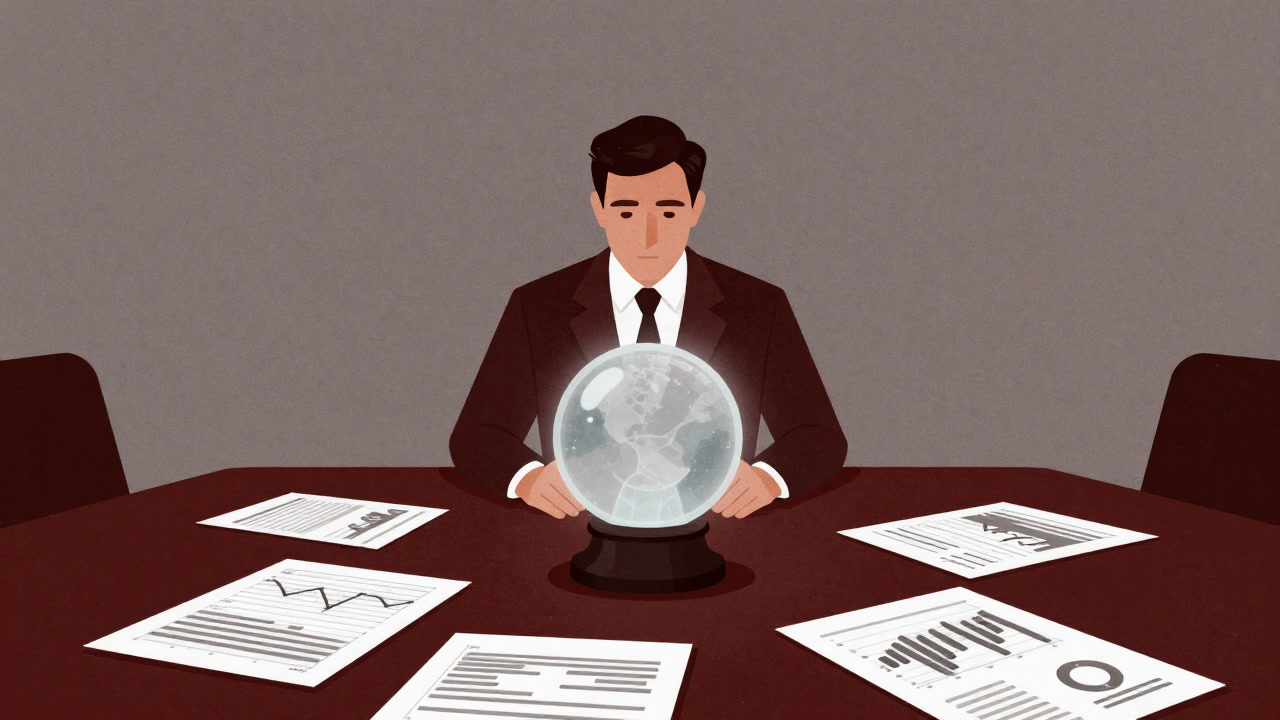
Description
Forecasting is the ritual offered at the altar of the boardroom, blending scant past data with hopeful speculation about the future. Analysts masquerade as soothsayers, more dedicated to the aesthetics of slide decks and blame avoidance than to accuracy. The moment a forecast fails, someone becomes the scapegoat and the resume of expectations is blackened. Forecasting dances on the razor’s edge between illusion and reality, leaving only anxiety and depleted budgets in its wake.
Definitions
- A calculated divination designed to price the future and postpone accountability.
- An official document for extending meetings and staging uncertainty.
- A hopeful graph predicated on inevitable failure.
- The corporate version of coffee-cup fortune telling that blends wishful thinking with numbers.
- A trend line of success rates spoken only in terms of year-over-year comparisons.
- A magical formula that shines brightest in budget review meetings.
- Shelved when wrong, honored with a fancy acronym when right.
- A pastime for pre-enjoying future disappointments.
- A charade to conceal uncertainty and manufacture comfort.
- A numerical magic trick that brings auditors to tears.
Examples
- “Next year’s sales forecast? No worries—nobody’s outdone it yet.”
- “Forecast model? It’s an Excel trap: comforting to see, but impossible to hit.”
- “They canonize forecasts in meetings, but in reality they’re just wishful thinking.”
- “Budget planning? First you craft an optimistic forecast, then you knead reality until it fits.”
- “If a forecast fails, someone has to take the fall, right? It’s a sacrificial relay.”
- “Tip for a great forecast? Ignore the analyst emails and polish your crystal ball.”
- “The analytics team’s forecasts miss the mark every time, yet they believe in the sanctity of numbers.”
- “Best blame-avoidance tactic? Drop the forecast first, then hold the post-mortem.”
- “This quarter’s forecast is so conservative it’s hilarious. Let’s sprinkle some hope on it.”
- “At the end of every meeting someone always adds, ‘And take this forecast as directional only.’”
Narratives
- At year’s end, executives gather for the ritual called forecasting, pretending to commune with numbers.
- Every time a forecast misses, the report thickens and meetings stretch into the night.
- Conservative forecasts are lauded as safety mechanisms, while bold numbers are branded devilish whispers.
- Strangely, it’s forecast accuracy that’s reviewed more than actual outcomes.
- Those who craft forecasts do not see the future but instead shift responsibility onto it.
- Graphs laden with hope are beautiful, and the excuses for being wrong are artistic.
- The chances of a forecast hitting the mark are slim, but the thrill of the review meeting is guaranteed.
- It’s always the forecaster who exhales relief in budget meetings.
- The gap between forecast and actual is a wrinkle in corporate culture.
- Forecasting is the act of refusing to learn from the past and filling the future with illusions.
Related Terms
Aliases
- The Future Seer
- Boardroom Oracle
- Number Priestess
- Spreadsheet Shaman
- Budget Prophet
- Trend Bard
- Hope Alchemist
- Excel Magician
- Data Dreamer
- Chrono Alchemist
Synonyms
- Desk Incantation
- Wishful Chart
- Numerical Omen
- Meeting Divination
- Illusion of Basis
- Trend Alchemy
- Expectation Magic
- Tabular Mirage
- Groundless Theory
- Future Buzzword
Use the share button below if you liked it.
It makes me smile, when I see it.