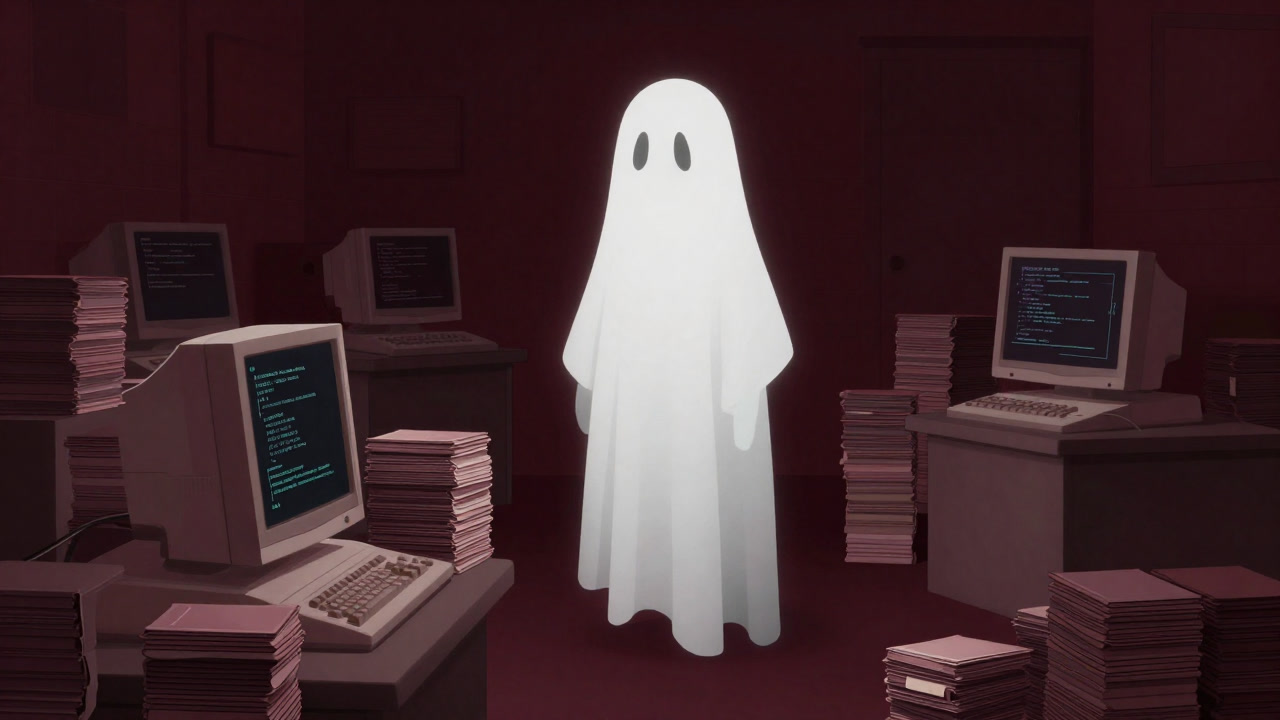
Description
Fortran is a venerable programming language whose archaic syntax resembles an archaeological relic. Astonishingly, it still reigns as the backbone of scientific computing somewhere on Earth. From the ordeal of punch cards to modern binary compilation, its survival through the ages is nothing short of legendary. Its syntax, often dismissed as ancient runes by newcomers, acts like a nostalgic incantation for seasoned veterans.
Definitions
- A compendium of ancient incantations dedicated solely to numerical computations, bearing both the honor and torment of scientific computing.
- A dojo for engineers to achieve Zen through the ritual of converting a few lines of code into dozens of assembly instructions.
- A language specification akin to the Tower of Babel, a relic of the punch-card era that humbles modern compilers.
- A strict prison that permits no freedom in code, bound by explicit type declarations and archaic line numbers.
- A paradoxical emblem of performance and practicality, optimized arithmetic meets inefficient I/O in eternal conflict.
- A source of melancholic pride, spawning legends of half-century longevity while being utterly ignored by modern IDEs.
- An underwater community cipher requiring unwritten consensus among maintainers spanning multiple generations.
- A time machine bridging past and present, oscillating between subroutines and machine language.
- A radical implementation philosophy that always sacrifices readability on the altar of numerical precision.
- A dialectic contradiction mocked as outdated by those chasing the cutting edge and venerated as scripture by tradition’s devotees.
Examples
- Fancy a mood boost with Fortran today? Relive the punch-card deja vu.
- Latest framework? Cute. But my heart belongs to line numbers and GOTO statements.
- Auto-format? First, can you handle the six-character margin rule?
- Error: Syntax error at line 10. Why not check that legendary line number first?
- You could do it in Python in five lines, but with Fortran you get five lines of five times the agony.
- Unvectorized code? Who cares? Optimization is just a myth.
- Debugging is more like a pilgrimage of inspecting punch cards one by one.
- Spending the night deciphering ancient incantations—now that’s romance.
- When a Fortran compile actually succeeds, it’s like grasping the Holy Grail.
- IDE? An editor and compiler suffice for a real programmer.
- Legacy code? No, Fortran is the monarch of legacies.
- Kernel development? Let’s start with Hello World in Fortran.
- Tired of sleek modern languages? Savor some ancient flavor.
- Backward compatibility? Fortran boasts thirteen generations of it.
- This 200-line Fortran program runs for a whole second. Performance? It’s all in the spirit.
- Modules? Ah yes, the cutting-edge library concept of yesteryear.
- Endless compile times are a hobby, really.
- Those line numbers double as timestamps, you know.
- Git? A stack of punch cards is way more romantic than repositories.
- Reading Fortran code is like feeling the lives of ancestors.
Narratives
- As night deepens, Fortran’s compilation errors pour out like an incantation of curses echoing through the lab.
- Scientists face their Fortran code as if deciphering an ancient artifact, finding glory and agony in each character.
- With colossal numerical tasks, Fortran lumbers like an aged ape yet steadfastly proves its reliability.
- Surrounded by mountains of punch cards, researchers treat source code like medieval manuscripts awaiting translation.
- The moment a Fortran program finally runs is the moment an engineer’s soul ascends to a digital heaven.
- Code tempered by decades of maintenance becomes myth, and newcomers decode comments with reverence and fear.
- Even before the latest benchmark hardware, whispers say ancient optimization algorithms hold the decisive edge.
- Hunting bugs by line numbers resembles prospectors searching for gold veins in a mine.
- A Fortran subroutine call is a solemn ritual to open the gateway to machine language.
- Accumulated macro definitions over the years are like pages from an ancient grimoire.
- In a world spawning fresh languages daily, Fortran stands alone like a solitary stone pillar.
- Deciphering compile option mysteries is akin to cracking the cipher on a treasure map.
- Researchers endlessly run Fortran tests day and night, ensuring their tower never collapses.
- To preserve the noble culture of line numbers, engineers still align code like ceremonial ranks.
- As precision obsession grows, code readability gradually hardens like onyx.
- In the realm of Fortran, even variable-length arrays can be deemed heretical.
- Only those who design massive I/O buffers truly grasp both their blessings and curses.
- Data exchange with other languages becomes diplomatic negotiations, with converters acting as interpreters.
- Sometimes scientists are saved by Fortran, sometimes they are toyed with by its dual-faced deity.
- Passing down code that looks like ancient runes is considered a programmer’s greatest legacy.
Related Terms
Aliases
- Legacy Monster
- Ancient Incantation Engine
- Batch Processing King
- Punch Card Ghost
- Line Number Monarch
- Compiler Beast
- Numerical Giant
- Syntax Prison
- Outdated Hero
- Cipher Specialist
- Scientific Computing Emperor
- Optimization Guardian
- Time-Travel Language
- Compatibility Hell-Maker
- Classical Circuit
- Debugging Ascetic
- Compile Dojo
- Ancestor Whisperer
- Heritage Keeper
- Transcendent Pursuit Language
Synonyms
- Stone Tablet of Science
- Prison of Formulas
- Tombstone of Technology
- Ancient Command Stele
- Miracle of Execution
- Oldest Language
- Spellbook
- Massive Batch
- Cipher Paradise
- Numerical Alchemy
- Sturdy as a Reindeer
- Holy Grail of Computing
- Pioneer of Black Boxes
- Veteran Memory Manager
- Real-Time Dream
- Asynchronous Sorcery
- Routine Master
- Scientist’s Attendant
- Significant Figure Supplicant
- Code Fossil
Use the share button below if you liked it.
It makes me smile, when I see it.