Description
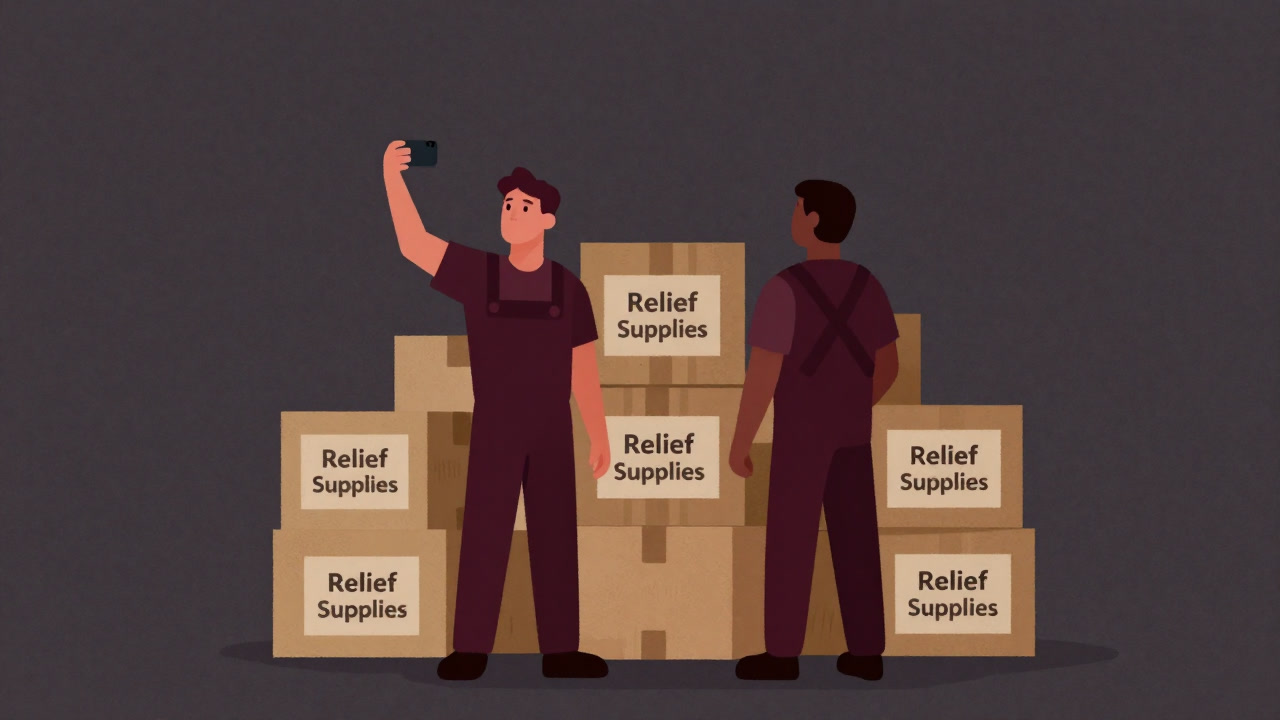
Humanitarian aid is the noble theater in which distant calamities are filtered through a veneer of goodwill, then shelved by bureaucratic rituals that digest budgets but not suffering. Relief supplies distributed on the ground often serve as mere props for commemorative photography, while recipients perform gratitude to a script. Donations are tossed into the glass box of a transparency report, only to sink into the abyss. Each time the spell of ‘sustainability’ is uttered, the circle of aid slowly tightens around itself, spinning without end.
Definitions
- A ritual of piling binders full of paperwork atop the rubble of warzones and disaster sites.
- A financial transfer event bearing the banner of goodwill, whose destination often leads to a transparent darkness.
- An endless circle of aid, recursively repeated under the incantation of ‘sustainability’.
- A public theater where disaster victims, meant to be protagonists, are forced to perform scripted expressions of gratitude.
- A professional performance tilting the balance of urgency and efficiency under the euphemism of ‘consideration.’
- The transport of relief goods resembles a traveling troupe subject to domestic procurement timetables rather than local road conditions.
- Purportedly listening to beneficiaries, but actually no more than surveys to be ‘acknowledged’.
- A flood of banners and logos decorating crises, wrapping harsh realities in colorful packaging.
- As evaluation reports dance with figures, real disaster zones quietly measure time backstage.
- A ‘market of goodwill’ born from competition among NGOs, where winners claim hefty donations and photo permissions.
Examples
- “Look at our truck filled with relief supplies. Mind if we grab a photo?”
- “Beneficiary feedback? Rest assured, we’ve collected all the survey forms.”
- “Next time, emphasize ‘sustainability’ more. It boosts donations, you know.”
- “Roads here are terrible? No problem—we have budgets and deadlines to ignore reality.”
- “If we miss the grant report deadline, our project simply disappears, doesn’t it?”
- “Most supplies are still unopened in warehouses. Inventory is my favorite hobby.”
- “A scenic rubble and a child’s smile—that’s a perfect shot for publicity.”
- “It’s ’emergency,’ so we cram in everything and anything!”
- “Our field staff know paperwork better than locals—classic dilemma.”
- “Today’s donation total hit $10 million; now we can make the report extra flashy.”
- “We said we’ll listen to field voices, but we only brought microphones.”
- “We need more heartbreaking images to increase impact, wouldn’t you agree?”
- “Our mission is nothing but monetizing goodwill.”
- “This aid vehicle lost its way again and ended up in a billboard photo.”
- “Relief supply selection? Oh, that’s Marketing’s decision.”
- “Sometimes, promotion trumps actual help on our priority list.”
- “I wish someone would open these boxes—it’d make a great catalog entry.”
- “Interaction with beneficiaries? No thanks, we have social media likes.”
- “Next, let’s give more exposure to our so-called ’local partner.’”
- “In the money-flow game called aid, we’re playing to win.”
Narratives
- The rescue team chased the fleeting smile of a child beyond the rubble, all for a smartphone shot.
- The distribution of supplies felt like a show where the press corps outshone the locals.
- Every morning, the field office held an emergency meeting to discuss slide count deficiencies in the PPT.
- Procurement officers prioritized budget spending schedules over actual community needs.
- Charts in the report artificially showcased ever-rising budgets with pleasing curves.
- Meetings with local partners devolved into a barren competition over the number of signed agreements.
- What arrived at the disaster zone wasn’t hope-laden aid but unopened cardboard mountains.
- Branded tents stood like billboards, draped in desert dust.
- Locals searched not for necessities but for the most photogenic signboards.
- Aid projects had their debrief schedules fixed long before they even began.
- ‘Emergency Response’ stickers were the most critical gear on every aid vehicle.
- Inside the locked warehouse, supplies languished in neglect as time marched on.
- Benefactor newsletters never carried a single genuine voice from the disaster zone.
- On the shore, it was hard to tell whether the piles were from the tsunami or the relief supplies.
- Before audits, the office buzzed with cheers and teetering stacks of paperwork.
- Most of the budget vanished into the depths of web bank accounts unseen by any eyes.
- To stage a sense of crisis, the reception was held in dimly lit halls.
- Report writers turned out to be nothing more than puzzle solvers of numbers.
- The concept of ‘community needs’ existed solely as an entry on the budget spreadsheet.
- Aid staff began their mornings not with relief efforts but with document issuance.
Related Terms
Aliases
- Goodwill Conveyor
- Stamping Machine of Relief
- Transparency Black Hole
- Relief Marketplace
- Charity Labyrinth
- Endless Collection Box
- Sustainability Matrix
- Victim Studio
- Banner Sprayer
- Gratitude Kit
- Donation Fountain
- Aid Pyramid
- Charity Post Office
- Report Generator
- Project Roulette
- Relief Stamp Rally
- Infinite Supply Furnace
- Monitoring Theater
- Guarantee Warehouse
- Emergency Stage
Synonyms
- Paper Camouflage
- Fund Juggling
- Festival of Hypocrisy
- Report Feast
- Disaster Collection
- Budget Consumption Show
- Tsunami of Paperwork
- Ornamental Aid
- Donation Simulator
- Support Mirror Ball
- Assessment Race
- Gratitude Convention
- Aid Jenga
- Emotion Prop Device
- Sustainability Card
- Goodwill Trading
- Needs Mapping Game
- Promo Bandwagon
- Safety Package
- Report Parade
Use the share button below if you liked it.
It makes me smile, when I see it.