Description
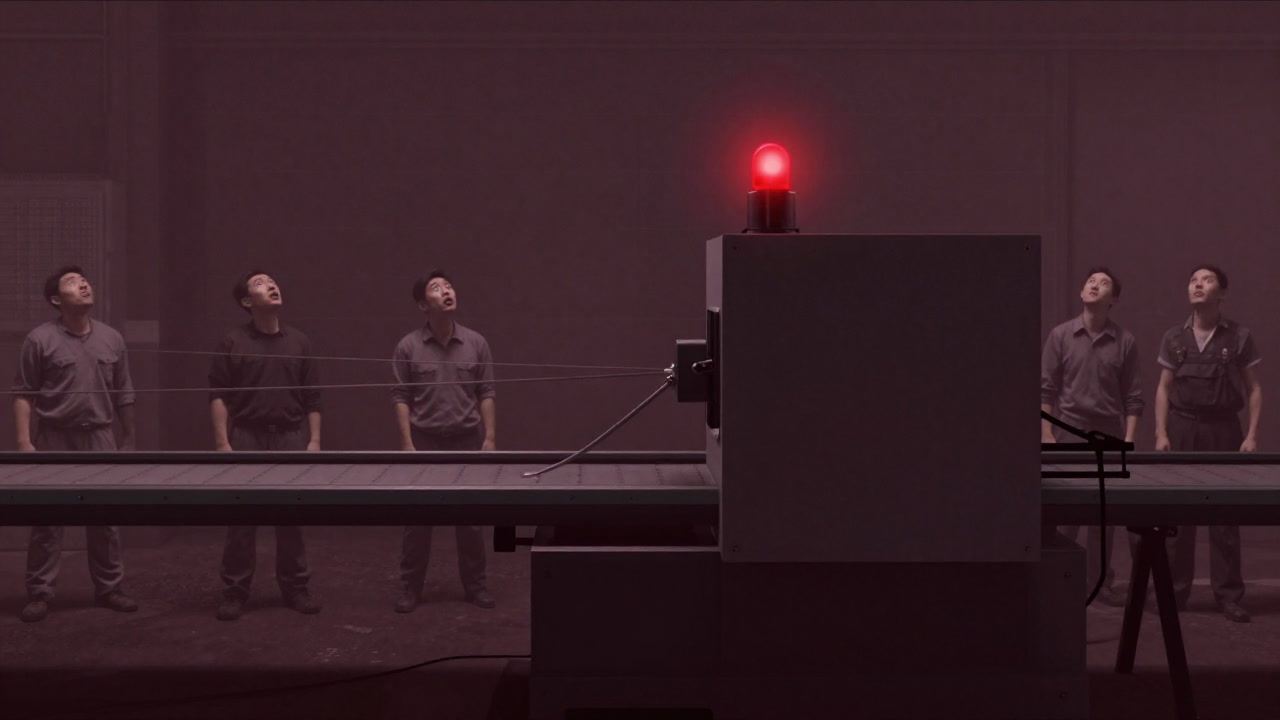
Jidoka proclaims the holy function by which a machine ceases operation upon detecting a flaw and summons a human to save the day. Under the guise of efficiency it offloads human error onto hardware, only to transform every stoppage into prime scapegoating material. On the shop floor the curiosity arises: “A machine stops, therefore humans get to work?"—a paradoxical exchange that defines daily reality. Ultimately, no matter how smart a production line claims to be, it can only advance when a human flips the switch—a cruel mirror reflecting our blind faith in automation.
Definitions
- A mechanized bell that halts at the slightest quality anomaly and forcibly summons an operator.
- A myth of production claiming unmanned operation while presupposing constant human supervision, a logical paradox.
- A distress signal that spotlights the dissonance between machine reliability and human fallibility.
- An automated summons system that atrophies human oversight even as it recalls workers unto the brink of burnout when faults occur.
- An inversion philosophy crushing the illusion that ‘running = safe’ and insisting that ‘stopping = quality assurance.’
- A strategic feature that gains time to conceal defects by stopping automatically and postponing blame allocation.
- A factory-contrast device exposing both machine perfection and human imperfection simultaneously.
- A post-rationalization of manual labor, justified by halting machines for each error to deploy human manpower.
- A breeding ground for internal politics under the guise of sensor-human collaboration.
- A high-performance document generator that simultaneously multiplies machine stoppage logs and staff complaints.
Examples
- “The line stopped? Oh, the quality alarm known as sabotage has commenced.”
- “Thanks to jidoka our labor productivity dropped—where do I file that report?”
- “Sensor false alarm? Or did the night shift operator doze off?”
- “The machine stopped so I got an extended coffee break. Jidoka is wonderful, isn’t it?”
- “Who decreed the golden rule: error → auto-stop → emergency meeting?”
- “Manager, was this feature designed for fans of inefficiency?”
- “Jidoka gave us labor shortage. Do we hire more workers for every stoppage?”
- “Automation to cut costs? What’s the plan when it stops?”
- “Quality control? No—stop control.”
- “If you seek perfect machinery, prepare for the infinite loop of jidoka.”
Narratives
- One morning the line halted, echoing the auto-stop signal. Facing the chorus of alarms, workers sighed, “Not again.”
- Jidoka is a magical curse that instantly transforms the shop floor into a battlefield under the guise of quality first.
- In front of every stopped machine, a congregation of engineers gathers to hear the oracle of jidoka.
- Designers preach ‘unmanned operation’ yet obsess most over the feature that summons humans.
- Jidoka is nothing but an invented rationality to make humans obey machines.
- The greatest irony is that the more jidoka you implement, the more management meetings you spawn.
- A machine that demands “Call a human” at every fault may well be the true overlord of the shop floor.
- What jidoka yields is rest under the name of stop and torture under the name of meeting.
- It’s pitifully transparent when you realize that humans pressing buttons are what actually keep the line moving.
- No matter how advanced, the moment a machine errs it proclaims ‘I’m helpless’—a ludicrous self-parody.
Related Terms
Aliases
- Quality Sabotage Device
- Stopaholic
- Time Loss Generator
- Meeting Launcher
- Detection Craver
- Emergency Summoner
- Kaizen Meeting Bomb
- Quality Showboat
- Conference Opener
- Auto-Stop Demon
Synonyms
- Stop Enthusiast
- SOS Button
- Machine Whimper
- Burnout Savior
- Efficiency Coated Trap
- Inevitable Interruption
- Neglect Prevention Gear
- Meeting Bloat Gadget
- Quality Theater
- Line Director
Use the share button below if you liked it.
It makes me smile, when I see it.