Description
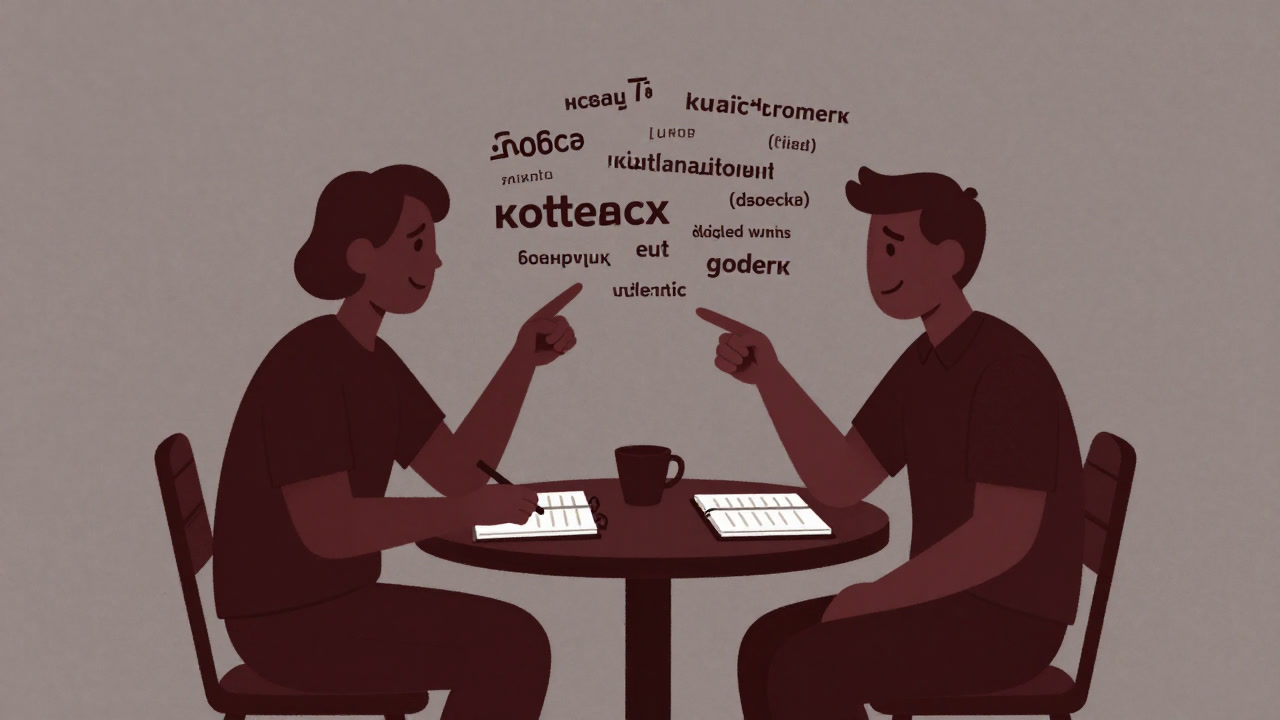
Language exchange is a two-for-one entertainment where you trade your mother tongue chips to sample another, pretending to learn more than you actually teach. In practice it becomes a confession booth of accent slip-ups and a costume party of cultural clichés, as participants endlessly recount their own weekend plans. Perfect grammar is mere ornamentation; stumbling through strange words is the true badge of bonding. It is the paradox of seeking independence by relying on each other’s limited patience.
Definitions
- A masquerade ball of socializing where two native tongues are exchanged but mostly broadcast personal anecdotes.
- A workshop in discarding the illusion of perfect grammar and celebrating the etiquette of giggling over mistakes.
- A missionary gathering in which one pretends to teach the other’s language while actually proselytizing one’s own culture.
- A one-person two-roles theater workshop in teaching and learning simultaneously.
- A mutual-recognition ceremony where participants toast each other’s progress more than true fluency.
- A sport where the simplest sentence sparks fierce debate and silence is ultimate victory.
- A tug-of-war of egos where it’s unclear whether you’re there to teach or to learn.
- An adventurous ascent of vocabulary cliffs with occasional falls into conversational abysses.
- A practice reliant on web translation more than dictionaries, whose shakiness lubricates the exchange.
- A forum valuing the bonding over shared errors more than the path to true mastery.
Examples
- “How was your weekend?” “Great. You?” “…Oops, I just talked about my own weekend again, sorry.”
- “Pronounce ‘gracias’ as ‘gla-see-as’ and you’re golden; culture lesson later.”
- “Am I better at this? No way, your pronunciation is so cute I can’t focus.”
- “You want to study Japanese? Sure, but first surprise me with your English.”
- “Don’t worry about the accent, it’s the feeling that counts… I swear you say that every time.”
- “This word has no direct translation, but I want to translate my feelings for you.”
- “Grammar mistakes are cultural trophies; we should celebrate them.”
- “Your country’s jokes need a three-line explanation before I can laugh.”
- “We were supposed to ask each other questions, but you’ve asked zero.”
- “You’ll correct my Japanese today, but your English… can stay charmingly flawed?”
- “I’ll teach you, but first give me your intro in your language.”
- “If we aim for perfection we’ll exhaust ourselves, so let’s just laugh ourselves tired.”
- “Language exchange is just an extension of chat apps.”
- “Your ‘hello’ is so adorable, I feel like I’ve learned enough.”
- “I’ll teach you Chinese next, but first the recipe for your national dish?”
- “No topics? Perfect time to talk endlessly about my hobbies.”
- “Key to language exchange: pretend you’re interested in their stories.”
- “Sessions only run overtime when I dominate the conversation.”
- “Language is a bridge, but it’s turned into my monologue stage.”
- “I’ll bring fresh mistakes next time!”
Narratives
- He called language exchange “a ceremony of cherishing mutual mistakes” and diligently rehearsed pronunciations before the mirror each day.
- The true venue of language exchange is not a classroom or cafe, but the hollow space where approval craving converges.
- Strangers meet through dubious apps and freely pass their mother tongues as if tickets at a carnival.
- The moment you ask for a grammar correction, your partner’s smile freezes—a classic move.
- She enjoyed language exchange as a shameful display of her limited vocabulary as performance art.
- The ultimate skill in exchange is how gracefully you navigate mutual silences.
- It mirrors social media in seeking mutual ’likes,’ leading only to emptiness beyond the screen.
- They mastered reading each other’s egos before any dictionary definitions.
- Weekly sessions turn into social battlegrounds rather than learning zones.
- His self-proclaimed ’native’ status was just a PDCA machine sharing translation sites.
- His partner became less a cultural guide than a master of self-introductions.
- As soon as you think you’ve learned a new word, a bonus stage of bizarre pronunciation laughter begins.
- Language exchange may not be a path to friendship but a stage for self-validation.
- Should deepen cultural understanding, but tragically morphs into personal bragging time.
- First five minutes for pronunciation checks; the rest is hijacked by personal PR.
- Gathered to learn, they really sought empathy, filling each other’s emptiness with words.
- Understanding others through language is just an ego performance claiming listener trophies.
- In cafes, whispers of approval in mixed accents echo like a choir of loneliness.
- Language exchange is the greatest entertainment of poking fun at each other’s mispronunciations.
- After session ends, only ’likes’ multiply, not vocabulary lists.
Related Terms
Aliases
- Mistake Festival
- Hello Show
- Ego Station
- Silence Survival Game
- Pronunciation Theater
- Language Carnival
- Accent Expo
- Chatter Exchange
- Vocabulary Dump
- Cultural Cosplay Party
- Dialogue Pageant
- Interactive Chaos
- Inefficient Merry-go-round
- Error Gala
- Answer Hunt
- Excuse Marathon
- Social Translator
- Chat Survival
- Speech Battle Royale
- Empathy Hotline
Synonyms
- Bidirectional Shiritori
- Pronunciation Bug Training
- Language Rollercoaster
- Cultural Bazaar
- Intro Terror
- Mirror English
- Talk Circus
- Dictionary’s Nemesis
- Lost-in-Translation
- Word Gladiator
- Communication Labyrinth
- Mutual Collapse Session
- Impromptu Translation Fest
- Grammar Labyrinth
- Conversational Tightrope
- Understanding Pretend
- Mistake Conspiracy
- Flood of Monologues
- Memory Making Meetup
- Casual Brainwash
Use the share button below if you liked it.
It makes me smile, when I see it.