Description
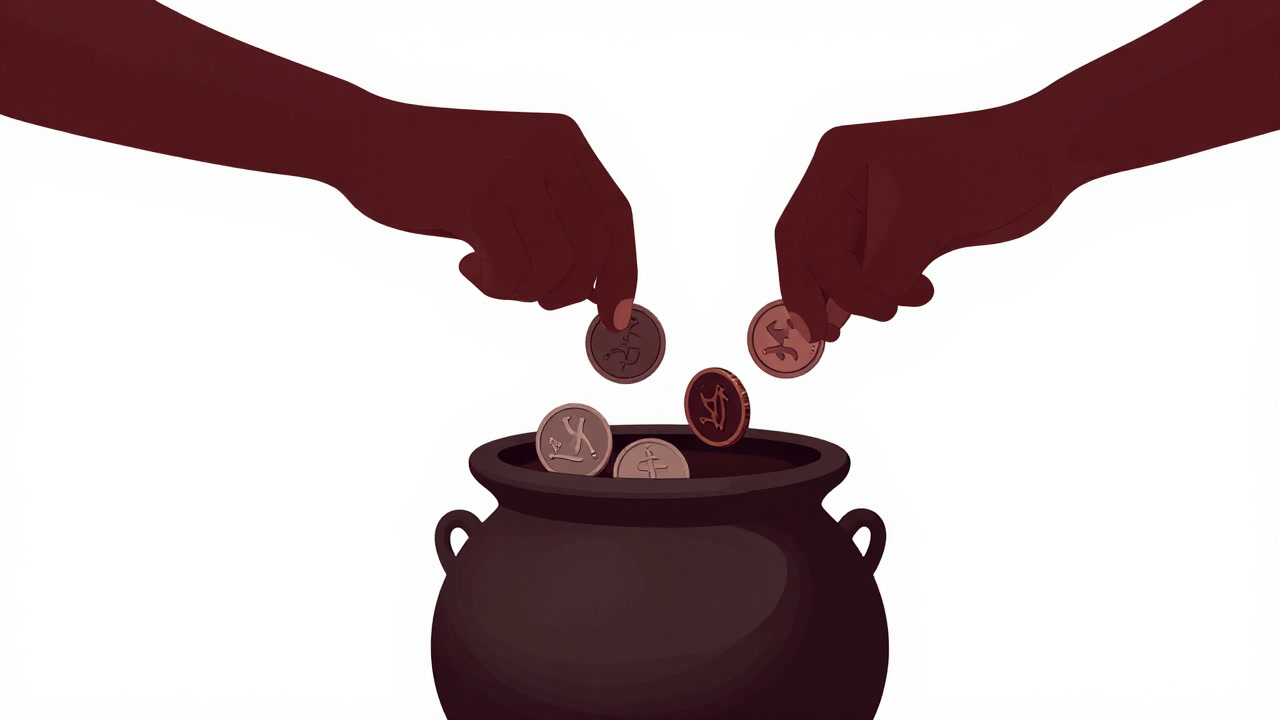
Mutual insurance is a ceremonious display of ‘philanthropy’ where collected premiums are pooled and distributed when misfortune strikes one member. It elegantly repackages others’ calamities as the trigger for communal benefit, while concealing the harsh reality that not every participant comes out ahead. In essence, it hides a structure of monetary indolence and abdication of responsibility behind the rhetoric of shared risk and security.
Definitions
- A formal communal wallet into which premiums are gathered.
- A capital pool that skims coins from everyone’s pockets at the hint of one person’s loss.
- A community that touts mutual aid but becomes a stage for dramatizing misfortune.
- It promises fairness yet vanishes into an administrative black hole post-payment.
- A ceremony of bureaucracy and paperwork that may only prove useful when disaster strikes.
- A paradox that claims to distribute risk but leaves everyone waiting for another’s misfortune.
- A cynical game where policyholders share anxiety and purchase peace of mind with money.
- A social alchemy stacking small premiums to forge the illusion of great security.
- An institutional escape that abdicates personal responsibility in favor of collective fate.
- A system whose communal purse trembles with the shadows of concealed inequality.
Examples
- “Disaster? No worries, we have a donation pot called everyone’s premiums.”
- “Mutual aid sounds nice, but it’s just a fishbowl of goldfish crowding around others’ misfortune.”
- “Premium payment day again? Is it a celebration or a begrudging duty?”
- “Why did the contribution rise again? Feels like I’m being squeezed in the name of cooperation.”
- “Mutual insurance gives peace of mind? Who becomes the sacrificial pig is left to chance.”
- “Better a distribution hell than distribution check, at least more surprising.”
- “I bet the payout melts away as administrative fees before it’s even paid.”
- “Call it mutual aid, it’s really a monetary joint front.”
- “For myself? No, it’s a showtime for everyone’s bad luck.”
- “Seeing the claim amount, I saw right through the system’s black humor.”
- “Full payout? What magic is that, governmental balancing act?”
- “Enrollment conditions? Basically asking if you want to gamble your fate.”
- “Why are we gathered today? Ceremony for premium collection.”
- “Kyosai? Literally ‘help each other,’ but it’s more like ‘squeeze each other.’”
- “Payouts depend on the steward’s wallet; we are mere reflections.”
- “Claiming insurance? That’s when the theatre begins.”
- “Your misfortune, everyone pays to view it.”
- “Collecting coins for ‘great peace of mind’? Such a phantom wish.”
- “Mutual aid meetings are forced donation competitions.”
- “To claim your mutual aid funds, prepare 50 forms and a ton of patience.”
Narratives
- When a disaster strikes, funds collected under the name of mutual insurance are first funneled into a pot called administrative expenses.
- What policyholders actually feel is not satisfaction, but the moral guilt of awaiting someone else’s misfortune.
- A mutual aid association is not a cooperative support group, but a bizarre social club where participants shove risks onto each other.
- At enrollment, a narrative of equal goodwill is spun, yet when payments falter, the same faces launch cold reminders.
- Under the euphemism of mutual aid, people unknowingly share anxiety and apocalyptically pray for calamity to come.
- When a payout finally arrives, they fume at its pittance, but unite in criticism to salvage a sense of solidarity.
- The amassed pool becomes vast, flowing out only when someone nearly drowns in misfortune.
- Of course, what first emerges is not personal relief, but mountains of paperwork and verification forms.
- Monthly premiums serve not the community’s welfare but fuel the administrators’ power.
- The irony of mutual insurance is that it promises distributed risk yet rescues only a tiny fraction.
- Idealists believe every member is an ally, but reality awaits with cold efficiency calculations.
- After a disaster, what you feel isn’t warm camaraderie but rage at all the administrative time wasted.
- Meetings of the mutual aid society resemble a deranged feast where participants compete in misery for dividends.
- Those who delay payments receive notifications as silent threats.
- As the risk pool swells, individuals fade into anonymous numbers.
- Rumors sometimes whisper of someone receiving a full payout, but no participant can confirm the truth.
- The mutual aid community teaches, by experience, that trust and money are separated by a thin line.
- Mutual insurance is called a safety net, yet no one guarantees the mesh’s strength.
- Ultimately, life or death is decided by administrative convenience, and goodwill transforms into poor wages.
- The endpoint of mutual insurance is either true solidarity or an altar of countless paper slips.
Related Terms
Aliases
- Risk Sharing Pot
- Exploitation Pool
- Mutual Collapse Fund
- Anxiety Assembly
- Spectacle of Safety
- Goldfish Bowl System
- Burden Disperser
- Monetary Ritual
- Everyone’s Wallet
- Misfortune Sport
- Vanishing Premium
- Paper Altar
- Collection Club
- Shameless Insurance
- Sadness Spectacle
- Privilege Pool
- Endless Claim Pot
- Insurance Comedy
- Outsourced Catastrophe
- Decorative Bond
Synonyms
- Risk Joint Front
- Co-aid Fund
- Premium Party
- Collective Debt
- Unlucky Pool
- Anxiety Piggy Bank
- Fairness Fund
- Masked Bond
- Irresponsible Mutual Aid
- Guarantee Mirage
- Social Tipping
- Luck Lottery
- Payout Show
- Offering Insurance
- Mutual Exploitation
- Happiness Token
- Trust Game
- Negative Gospel
- Paper Assurance
- Virtual Safety
Use the share button below if you liked it.
It makes me smile, when I see it.