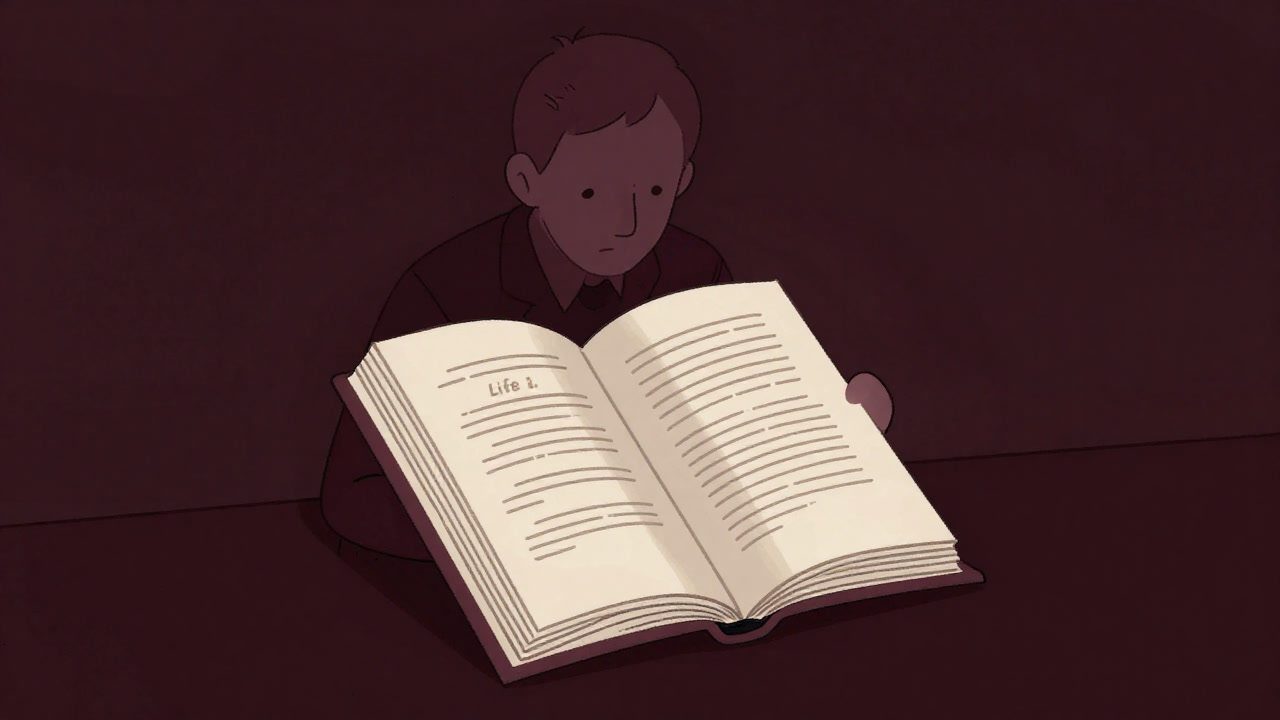
Description
Narrative Therapy is a dialogic self-editing process in which individuals narrate their lives as stories, aiming to escape the labyrinth of the mind. It’s a magical talk show that boosts self-esteem simply by speaking the right lines. In practice, it cleverly retraces a form of structural critique while comfortably avoiding real risks or challenges. This curious method simultaneously produces the freedom to edit one’s life chapters and the paradoxical barrier that prevents true completion.
Definitions
- A self-satisfying oral literary editing process that treats one’s life as a book and carefully picks up scattered pages from the depths of the psyche.
- A narration magic that talks about problems and pain as if they were mere passages, diluting the depth of wounds.
- A sub-digital version control where therapist and client reconstruct story plots to attempt a self-image update.
- A psychological reboot that reintroduces past traumas as characters, prompting a confrontation with the reader, the client.
- An implicit edit feature that fills unwritten interludes with silent interpretation and quiet pauses.
- An emotional SEO tactic that optimizes the narrative to gain others’ empathy and target self-validation as a reward.
- A story maintenance practice that continuously re-translates the self-image positively to delete negative drafts one by one.
- A psychological quality control method that partitions narratives and inspects fragments of the mind piece by piece.
- A self-expansion marketing that calls the silence after telling one’s story a success and lures you to the next chapter.
- An introspective jigsaw puzzle that searches for invisible seams after the wounds have been bandaged by words.
Examples
- ‘My story keeps spiraling… can you reset the narrative?’
- ‘If talking changed everything, I’d go on a daily speaking tour.’
- ‘Narrative Therapy? Lip service to heal the mind with words, right?’
- ‘I’ll re-edit my story for a self-upgrade… there will probably be a few bugs left.’
- ‘Doctor, my trauma keeps stealing the spotlight again.’
- ‘When I script my life, I’m terrified of the end credits.’
- ‘I thought telling my story would solve problems, but I just got tired.’
- ‘If I can write my own ending, I’ll show you how it’s done.’
- ‘Telling equals healing is too simplistic—no actual action involved.’
- ‘I have so many characters inside me, I don’t know who to talk to.’
- ‘Externalizing the narrative is just offloading onto someone else, isn’t it?’
- ‘The moment I finish sharing, a new chapter planning session begins.’
- ‘Should my story be free-form or divided into chapters?’
- ‘Every emotional climax makes the therapist’s eyes dart around.’
- ‘Making myself the protagonist is the ultimate self-indulgence.’
- ‘I wonder, ‘Again with the storytelling?’ yet I can’t help but speak.’
- ‘After narrative therapy, I feel like a rookie writer being edited for free.’
- ‘If I turn my life into a story, the acknowledgments will say ‘to my readers’ patience.’’
- ‘Even after finishing, every reread demands a new afterword.’
- ‘I should love my story, but instead I start an editorial war of self-hatred.’
Narratives
- The client wandered deeper into a maze of words as they narrated their life story.
- The therapist listened quietly, meticulously recording the process like a screenwriter.
- The silence after the final word felt like both a fleeting triumph and an eternal exit.
- Past chapters resurfaced in grand spectacle, while unpublished interludes were gently concealed.
- Each new narrative plot suggestion dragged the characters back into a vortex of choices.
- The unfolding session resembled a circus tightrope act between self-interpretation and structural critique.
- Asking ‘How did your story begin and how will it end?’ felt like a kick to life’s core.
- Sometimes the client’s words became knives, turning self-narration into a cruel ritual.
- Unspoken chapters kept silent, as the therapist became an artisan weaving subtext.
- A story completes by ending, donning a fragile beauty that vanishes upon fulfillment.
- Revisiting the past was a journey booby-trapped by the loops of memory.
- The self-image the client saw was a distorted reflection in the therapist’s mirror.
- Uttering one’s narrative offered a key to both liberation and self-imprisonment.
- Every new chapter idea accelerated the decay of old fragments.
- Self-narration is entertainment, and the audience is always one’s inner self.
- Covering wounds with words creates a paradox in which hidden truths sink deeper.
- Whoever holds the editing rights of the narrative becomes the ultimate ruler of the story.
- The therapist’s quiet nod sometimes delivered the heaviest judgment.
- An intro brings hopeful music, while the ending leaves a silent afterglow.
- As the session ends, an endless conference within the mind begins, beckoning the next act.
Related Terms
Aliases
- self-editing machine
- narrative priest
- pain storyteller
- alchemy of words
- mind commander
- memory traveler
- word blacksmith
- emotion screenwriter
- listener brigade leader
- archive of memories
- emotion crash course
- narrative customizer
- past patch applier
- self-rewrite professor
- story sysadmin
- mind navigator
- inner debug tool
- emotion version controller
- story editor-in-chief
- narrative plugin
Synonyms
- story workshop
- mind library
- magic mirror of words
- emotion logbook
- memory script archive
- fuel of narratives
- self-interpretation workshop
- past stand-in
- backstage of introspection
- emotion release valve
- sketch of thought
- narration factory
- mind module
- emotion sketch
- narrative lab
- self-exploration algorithm
- story nourishment
- memory generator
- word sanctuary
- inner refrain
Use the share button below if you liked it.
It makes me smile, when I see it.