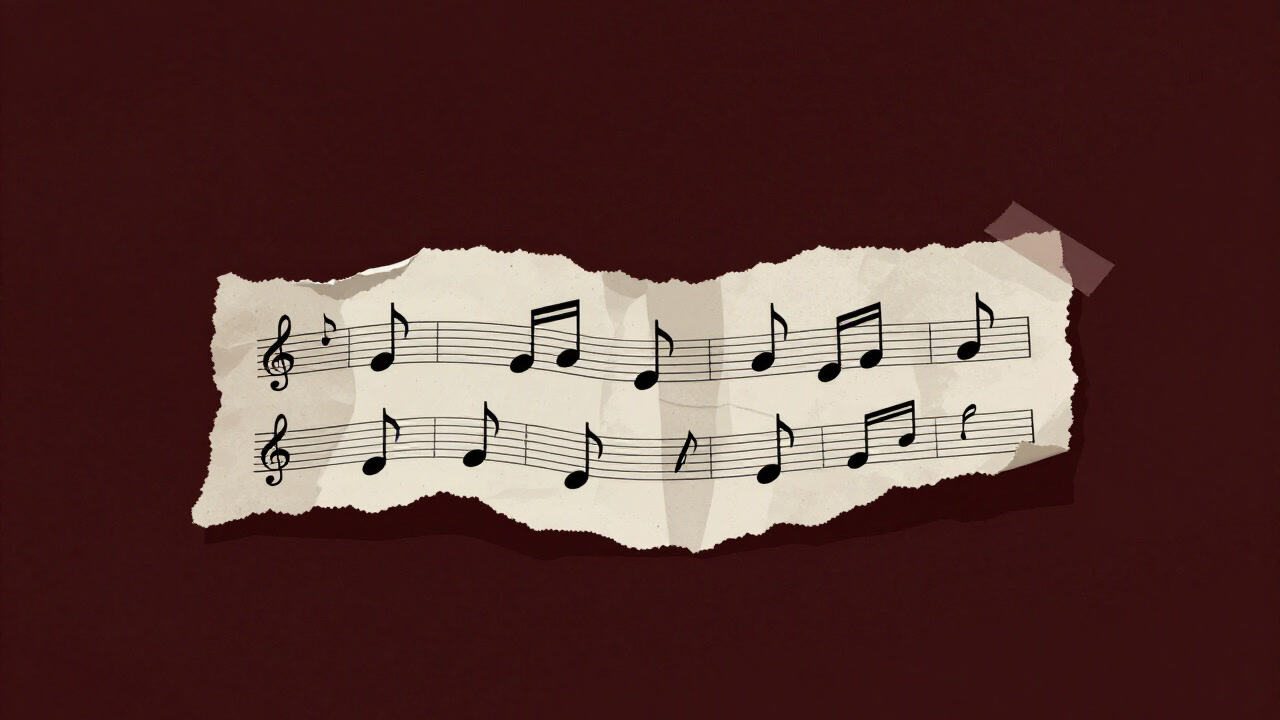
Description
Sheet music is a paper inscribed with rows of notes, formatted as art yet forcing musicians into constant translation. The symbols meant to narrate beauty transform into cryptic codes that terrify the performer. The neatly aligned staves spark endless interpretive chaos rather than clarity. Musicians are lauded for depending on it, but it often breeds idiosyncrasies and mistranscriptions, ultimately stifling true improvisation. In the end, the pursuit of precision only builds a paradoxical cage around art.
Definitions
- A labyrinth on paper promising a musical roadmap while turning the journey of expression into an endless maze.
- An artful promise of melody that morphs into an indecipherable code amidst a sea of symbols.
- A tool meant to convey the composer’s intent, yet one that suppresses the performer’s individuality.
- Praised as the textbook of music theory, but in practice a battleground of protests and grudges.
- A neatly ordered staff concealing countless sparks for interpretive wars.
- A duet of freedom and tyranny, promising expressive liberty while imprisoning performers in dense instructions.
- A de facto aptitude test for readers, inducing panic under the guise of rehearsal.
- An unfinished contract filled with unnoted errors and omissions.
- A silent dictator controlling the accompanist’s timing while refusing to speak itself.
- A wall of sound built from rows of symbols that entices universal interpretation yet isolates each performer.
Examples
- “Got the new sheet? It’s like an encrypted message… Is this a battalion of notes?”
- “Tempo marking at 120? My heart can’t keep up…”
- “They say the score is flawless—flawless at driving performers to despair, maybe.”
- “With a baton, who needs sheet music? We’ll just wing it with some flair.”
- “No music stand? No worries, reading it off the floor adds a certain thrill!”
- “Five sharps in G major? That’s what I call pure malice.”
- “There are so many repeat signs I have no idea where to end… an endless purgatory.”
- “Are those notes dancing? No, they’re being forced to dance.”
- “Sight-reading? Don’t make me laugh; my heart freezes the moment I open it.”
- “Is this score misaligned? Looks like modern art to me.”
- “The composer said feel free to interpret, but how does one even start?!”
- “I’m lost in a forest of slurs and ties… when is the exit?”
- “Advanced level? Even intermediate players want to cry.”
- “Maybe if sight-reading were a sport, it’d help… nope, still impossible.”
- “I can see the staff lines… In a way, it’s horror.”
- “Play by the book and you sound like a robot.”
- “Note-reading speed contest? It’s a full marathon that never ends.”
- “Octave markings? I thought my fingers were about to tear off.”
- “Rests are scary. Silence can hurt worse than noise.”
- “Sheet music: the ultimate pop quiz for musicians’ souls.”
Narratives
- Sheet music appears as the perfect blueprint yet serves as a magical paper forcing infinite anxieties and interpretations upon the musician.
- The notes flowing across the staves sometimes dance beautifully, sometimes cruelly slice the performer’s confidence.
- The silence of a rest is a silent curse that implants the deepest terror in the musician’s heart.
- Once lost in the labyrinth of repeat signs, performers are bound by the spell of never-ending endings.
- Balancing between the composer’s intent and the performer’s interpretation, sheet music always breeds losers in its battle arena.
- Many players say sight-reading practice is as monotonous and grueling as weightlifting for the soul.
- Perfect symbols in music theory books often become hotbeds of confusion and misreading in practice.
- Any score labeled ‘Advanced’ is essentially a personal challenge letter.
- When placed on a music stand, sheet music is both a sacred text and the ultimate troublemaker.
- Even the same piece shows a different face when arranged by someone else, making the score a master of betrayal.
- A typo discovered just before a performance becomes the culprit for a musician’s sleepless night.
- Players tormented in sight-reading competitions march on to the next rehearsal nursing a grudge against the score.
- Contests for reading speed have become brutal sports far beyond mere competition.
- The notes inscribed on the staff mirror the soul of the piece and act as a microscope revealing the performer’s flaws.
- When a musician errs, the score silently shoulders the blame without protest.
- Digital sheet music seemed poised to render paper obsolete, yet stacks of printed sheets still rule rehearsals.
- Not just in classical settings, sheet music remains the protagonist of trials for pop and jazz musicians alike.
- The more precise the notation, the greater the tension at performances and the higher the musician’s blood pressure.
- A page-turning failure is considered a sacrilege, ripping the ritual of performance to shreds.
- Even the ultimate improviser cannot escape the shackles of sheet music for the initial melody.
Related Terms
Aliases
- Musical Enigma
- Note Maze
- Performer Torture Rack
- Staff Prison
- Note Battalion
- Cipher Tool
- Instruction Manuscript
- Paper Dictator
- Audio Contract
- Unreadable Hell
- Sheet Minefield
- Rest Bomb
- Repeat Curse
- Printing Dungeon
- Silent Overseer
- Tie and Slur Labyrinth
- Music Textbook
- Guide Through Darkness
- Page-Turn Beast
- Note Prisoner
Synonyms
- Graveyard of Notes
- Score Curse
- Performer’s Nightmare
- Pile of Symbols
- Instructional Inferno
- Decoding Landmine
- Melody Cage
- Precision Penalty
- Forced Guide
- Self-inflicted Tool
- Instant Death Text
- Interpretation Puzzle
- Musical Contract
- Theory Jail
- Cipher Score
- Barriers of Staff
- Expression Ban
- Prison of Lines
- Melody Mandate
- Unsingable Paper
Use the share button below if you liked it.
It makes me smile, when I see it.