Description
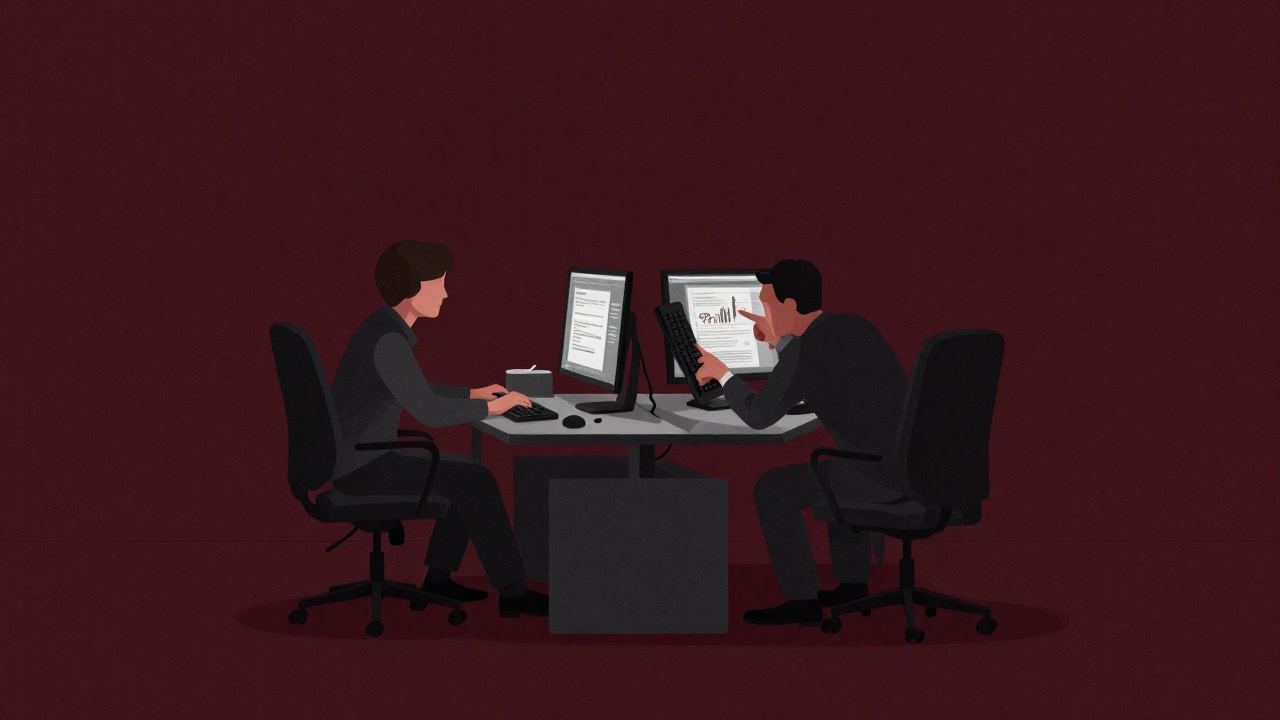
Pair programming is the competitive ritual wherein two developers fight over one keyboard and one chair. Ostensibly for “quality improvement” and “knowledge sharing,” half of the dialogue is actually a blame-shifting contest disguised as code review. If work slows, it’s ‘because of your pair’; if productivity spikes, it’s ‘thanks to teamwork’—a corporate logic labyrinth. While heralded as a fast problem-solving technique, each new pairing brings fresh onboarding costs and dissonance. The true face of pair programming is the faint hum of mild office agony and unspoken pressure.
Definitions
- A ritual where two programmers fight over one keyboard while shamelessly exposing each other’s mistakes.
- A corporate theater billed as productivity enhancement, but where conversation time outpaces coding time.
- A guise for knowledge sharing that swiftly devolves into a masquerade to hide one’s own ignorance.
- A miracle session meant to exorcise bugs but ends up spawning new bugs and communication gaps.
- Promoted as ‘faster than reviews,’ yet it demands twice the time for consensus building.
- A social penance that replaces solitary coding loneliness with a double dose of awkwardness.
- A bidirectional anonymous audit of each other’s commit history, rather than mutual celebration of progress.
- An educational playground of development where every role swap feels like newborn induction training.
- A collective dependency protocol where one partner’s snooze can derail the entire team’s schedule.
- A cost demon that sacrifices solo productivity hours at the altar of supposed collaboration.
Examples
- “Your typing is like a snail. Should I slow my responses too?”
- “This bug is totally your comment style’s fault. I’m flattered you noticed.”
- “Is it faster than solo? We’ve just talked for thirty minutes.”
- “Pair programming benefit? Oh, you get someone to talk to.”
- “Shall we swap drivers? Now it’s your turn to bash the keyboard.”
- “Faster than code review? I see more talking than reviewing.”
- “Break already? You can’t share your pair’s fatigue, you know.”
- “I think this code breaks because of you. Any objections?”
- “I love the ritual silence that erupts the moment an error appears.”
- “Does hearing ‘agile’ make you crave pair programming?”
- “Elbow on the keyboard is a breach of etiquette.”
- “Your typing sounds like background tinnitus.”
- “Who I pair with sets the mood for my entire morning.”
- “If my pair catches a cold, my progress halts too.”
- “Don’t trust your code. I don’t, but let’s pretend.”
- “Time to vote for the next pair. Welcome to the office lottery.”
- “Let’s optimize conversation to boost productivity.”
- “Coding is tiring enough; talking about coding is even more exhausting.”
- “Your intense gaze scares me more than a runtime exception.”
- “Pairing joy? Splitting the pain in half sounds about right.”
Narratives
- Pair programming is a mad session where two coders simultaneously scratch their heads at the same error.
- In a quiet office, dual typing sounds give rise to a bizarre theater stage exclusive to the pair.
- Under the guise of optimization, they debate variable names ad infinitum, only to find themselves filing overtime requisitions.
- Roles like ‘driver’ and ‘navigator’ are nothing but sophistic splits of labor to offload one’s own work onto the other.
- New pairs begin with an intelligence war to uncover each other’s coding quirks.
- At the moment of transition, everyone fears the role-change ritual and yearns for a timeout.
- Under the promise of teaching, one partner foists unknown framework knowledge onto the other.
- Beneath the heroic tale of collective responsibility lurks an opaque sloth competition over who truly birthed the bug.
- When conversation stalls, pointless small talk accelerates to fill the void.
- In remote setups, they share each other’s desperation and emptiness through a screen.
- The ‘best practices’ in textbooks dissolve entirely under the banner of pair programming.
- They operate the keyboard as one, yet their hearts remain with a cautious step of distance.
- When the pairing-change bell rings, everyone breathes relief concealing anticipation of fresh stress.
- The slogan of productivity improvement is in fact a test of patience to silently accept your partner’s corrections.
- After pairing, the resulting code mysteriously becomes a masterpiece no one can claim as their own.
- When an error appears, they assert roles yet decide the true culprit through silence.
- ‘Pairs are friends,’ the company anthems, but in reality it’s a shared poison of obligation.
- Unresolved bugs linger in their minds like a hangout spot postponed to the weekend.
- When a partner offers advice with a smile, it hides a silent warning of ‘You might want to stop.’
- After work, the light greeting of ‘Good fight today’ carries a profound sense of exhaustion.
Related Terms
Aliases
- Code Co-star
- Bug Buddy
- Single Keyboard Deathmatch
- Joint Spell Casting
- Double-Check Hell
- Synchronous Abyss
- Duel Pair
- Deathmatch Keyboard
- Commit Judge
- Mental Shutdown Pair
- Dual Work Trend
- Mutual Siege
- Copy and Blind
- Face-to-Face Mystery
- One Machine One Duel
- Mutual Obliteration Pair
- Two-Headed Processor
- Battle Keyboard
- System of Mutual Ruin
- Discord Generator
Synonyms
- Joint Front
- Bug Coop
- Keyboard Scramble
- Torture in the Name of Collaboration
- Face-to-Face Communication Game
- Two-Person Kimono Coding
- Mutual Review Survival
- Pair Collaboration Load
- Mutual Check Play
- Commit Sharing Protocol
- Double-Tap Trap
- Collaborative Death March
- Communication Training Ground
- Reliability Buffer
- Dependency Workflow
- Code Coupling
- Shared Responsibility Protocol
- Bug Verification Grill
- Dual Responsibility Circuit
- Interactive Torment
Use the share button below if you liked it.
It makes me smile, when I see it.