Description
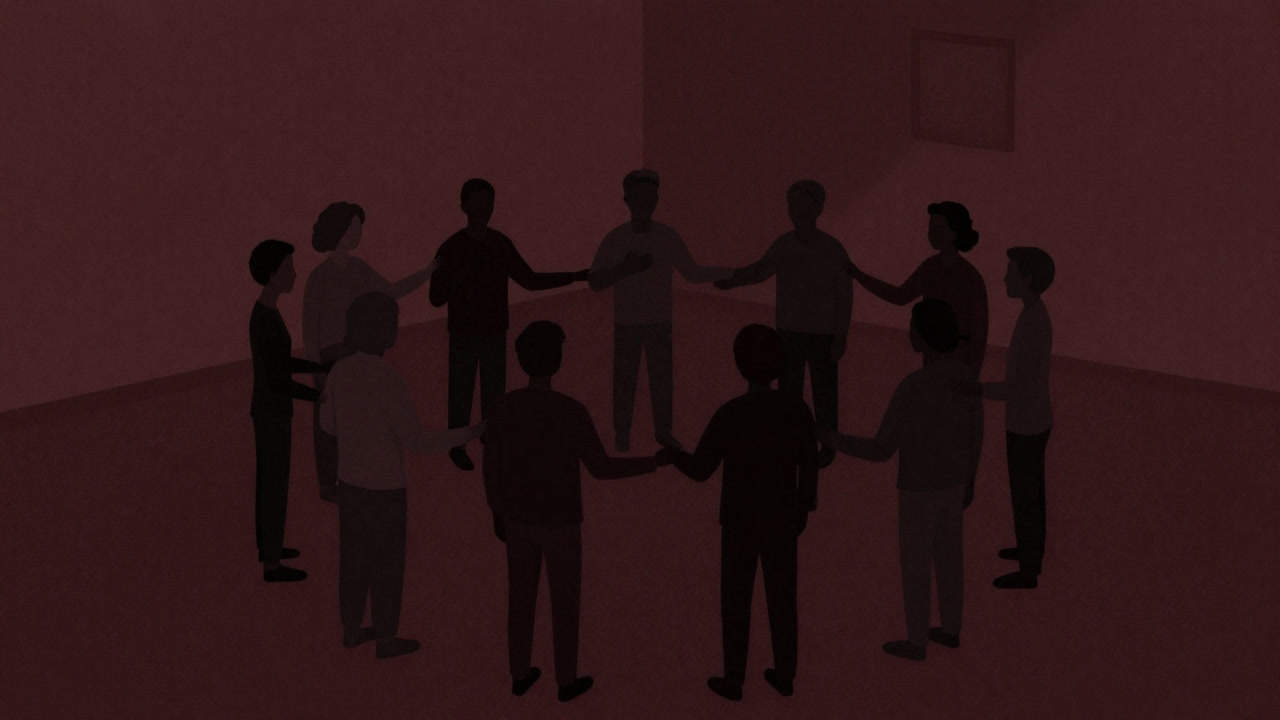
Peer support is the ritual in which unqualified companions gather to pass around each other’s problems as if sampling a fine wine. Neither official therapy nor casual advice, it serves as the community’s favorite buffer that sometimes leads participants deeper into confusion. It swaps empathy for pseudo-comfort, endlessly dancing the social waltz that diverts attention from the root of distress. Occasionally it works miracles with precise encouragement, and other times it traps everyone in an infinite loop of mutual consolation—a black hole of human relations.
Definitions
- A pact of the unlicensed where each disturbs the other’s mind under the guise of amateur empathy.
- Not official therapy, yet a community workshop that reproduces troubles under a cloak of false reassurance.
- Also known as the ‘misery loves company’ alliance, a magical network that promotes mutual downfall over solutions.
- An emotional marketplace exchanging empathy coins according to the depth of one’s anguish.
- A social game where offered shoulder pats unexpectedly become seeds of irritation.
- The more you bare your soul, the more it becomes an echo chamber that later drowns out your voice.
- A chain device that traps you in an infinite loop once you taste the first experience of success.
- An altar of paradox which preaches sharing weakness but actually spawns new anxieties.
- An eternal handover ceremony where one person’s encouragement ends and another brings fresh wounds.
- A breeding ground for palliative care approaches, hiding the true solution in the outer world.
Examples
- A: Can you listen to my troubles again at the peer support? B: Sure, but I’ve been struggling with the same thing since yesterday.
- A: I’m in pain… B: I am too. How bad is it?
- A: Give me advice! B: First, can you lend me an ear about my issue?
- A: I can’t solve it. B: Let’s grab a coffee. Talking might ease it.
- A: Thanks. B: But you might need me just as much.
- A: I’m at my limit… B: Hearing that makes me tired too.
- A: Somebody help… B: I thought we said helping each other; now it’s your turn to listen.
- A: What did you think about yesterday’s talk? B: I can relate deeply; I was struggling with it too.
- A: Why no advice? B: Advice is something you find yourself, right?
- A: Thanks for listening. B: But I don’t expect any solutions.
- A: This story again? B: Empathy is important, after all.
- A: I have low self-esteem… B: I get it; I don’t know myself either.
- A: I want to confide in someone. B: Want to try me first?
- A: I need more help. B: Those words are heavy—are you okay?
- A: Does peer support actually work? B: It’s a tradition beyond measurable outcomes.
- A: I want encouragement. B: Finish your story before I encourage you.
- A: Does talking really help? B: You’ll learn the pain of false hope.
- A: Mind care? B: Only you pace your own care.
- A: Everyone has the same worries… B: And shared troubles illuminate a deeper darkness.
- A: Who’s next to share? B: Welcome to the never-ending consolation gala.
Narratives
- In the peer support hall, unlicensed ’listeners’ gather to sip each other’s exhausted minds in a twisted potluck.
- One person’s lament births another’s sorrow, and before long everyone is engulfed in a silent whirlpool.
- It mass-produces addicts to the drug of empathy, spawning an infinite hell under the guise of group therapy.
- Participants crave solutions, yet find perverse pleasure in repeating the same ritualized stories.
- The fingertips that tap shoulders carry a faint heat of irritation more than encouragement.
- ‘Your voice saved me’ can become a spell that burdens someone with yet another weight.
- Peer support is the prime water for collective downfall, a department store vending the illusion of comfort.
- Stock phrases exchanged with smiles stain the meeting room with the mildew of anxiety.
- The endless circle of sharing dwindles into a contest of wallowing in wounds rather than finding cures.
- Psychology jargon flies around, but most serve as codes that awaken each other’s confusion.
- Sharing one’s true feelings is sweet, yet also a trap that sucks in another’s darkness.
- The oath ‘let’s do this again’ becomes a pitfall that awaits more unplaceable emotions.
- Those brave enough to leave the circle often taste the alienation and loneliness instead.
- Empathy facilitators unconsciously foster the participants’ negative emotions as shadow directors.
- Behind slogans of growth, a silent ritual of self-sacrifice progresses.
- By the time they leave, everyone carries worn-out pieces of the heart on the journey home.
- The catchphrase ‘let’s support each other’ is an invitation to co-dependency.
- The small successes celebrated in peer support turn into nothing but residues of the past once over.
- The circle of support can sometimes become chains, iron bars that bind free thought.
- Ultimately, participants have no choice but to drown in a sea of fictional security.
Related Terms
Aliases
- Emo Cargo Gossip
- Trouble Twister
- Sympathy Share House
- Mutual Downfall Mart
- Emotional Piggy Bank
- Consolation Machine
- Unlicensed Wagon
- Complaint Hotline
- Emotion Recycler
- Pseudo-Comfort Factory
- Comrade Conspiracy Bureau
- Empathy Land
- Mental Buffer
- Support Ward
- Group Self-Care
- Weakness Relay
- Heart Convenience Store
- Self-Abuse Barter
- Whine Exchange
- Neverending Comfort Party
Synonyms
- Emotion Swap
- Weakness Trade
- Empathy Matching
- Trouble Café
- Emo Party
- Pain Pair
- Lament Share
- Healing Maze
- Worry Club
- Grievance Gala
- Heart Flea Market
- Anxiety Dealer
- Tears Circle
- Co-Dependency Fest
- Sorrow Round
- Dark Alliance
- Unbeatable Resonance
- Healing Trap
- Spill Network
- Consolation Arena
Use the share button below if you liked it.
It makes me smile, when I see it.