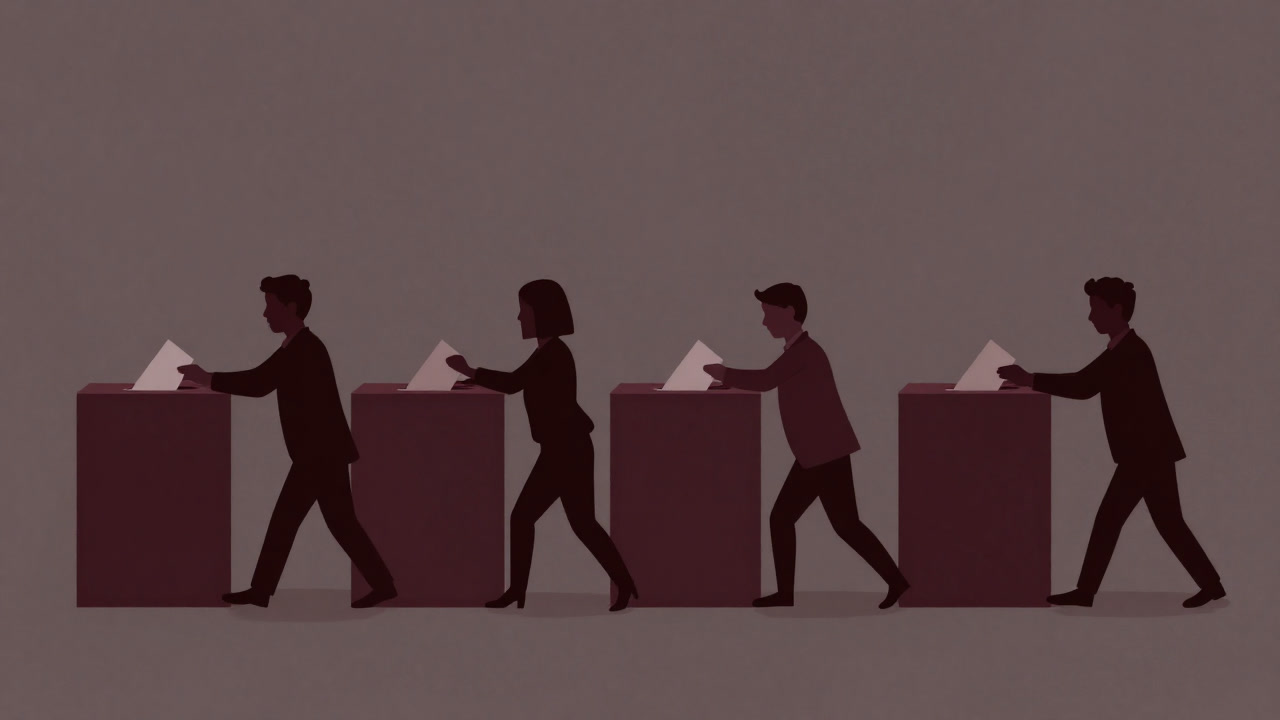
Description
Public choice is the grand festival of democracy where everyone proclaims their desires while shirking the burden of fulfilling them. Behind the noble guise of aggregating individual self-interest for the public good, vote trades, subsidies, and backroom deals dance wildly. Economics and politics enter a clandestine affair, holding an auction of souls at the voting booth marketplace. The theory is elegant, reality is warped by rent-seekers. In the end, all that remains is a chaos no one truly controls.
Definitions
- The backstage of democracy where personal self-interest covertly steers collective decision-making.
- A legally sanctioned black market where money trades votes under the guise of public good.
- The factional pageantry of politicians buying support like party favors.
- An economic circus in which public welfare and private desire collide under a big top.
- A school that places voting behavior alongside macroeconomic models on the same seminar table.
- Radical rationalism that treats elections as markets and voters as customers.
- An attempt to explain public decision-making through the chaos of bounded rationality.
- A theater of scheming interest groups rewriting the rules mid-performance.
- A hobby of weighing policy choices on the scale of cost–benefit analysis.
- An intellectual box that savors the paradox of ideal voting fairness and realpolitik maneuvering.
Examples
- “Public works? It’s really an art of adjusting interests, taught as ‘public choice’ to students.”
- “Election pledges? Oh those are just menu options for interest negotiation.”
- “They say they listen to everyone, but in practice it’s just the loudest lobby that wins.”
- “If you study public choice theory, start by tracing the hidden money flows.”
- “Government works for the public? No, like markets, it depends on sponsors.”
- “Budget allocation isn’t math, it’s politics—that’s public choice for you.”
- “Going to vote for self-realization? More like showcasing your self-interest in public view.”
- “Providing public goods? More like practicing the art of interest mediation.”
- “Someone’s voice becomes policy… but usually someone else pulls the strings behind the scenes.”
- “Do those who build careers in public choice theory actually believe in it?”
- “Taxes are for everyone? They exist because politicians love to have them.”
- “The conclusion of public choice? In the end, money talks, everyone else walks.”
- “Fair politics? Possible in theory, until someone rewrites the rules.”
- “Policy-making is an auction—highest bidders get to run the show.”
- “Thanks to public choice, political science finally looks like theatre.”
- “Everyone making wise choices… that’s fantasy for the classroom.”
- “Considering election costs, turnout is just a statistic nobody cares about.”
- “Researching public choice? It’s just shaking hands with interest groups behind closed doors.”
- “The public choice textbook reads like a manual for the backstage of reality.”
- “Public choice is the interdisciplinary gala of self-interest culture.”
Narratives
- On election day, polling stations transform from forums of ideal debate into markets ruled by loudmouths and ad budgets.
- Researchers of public choice sketch utility functions on whiteboards while reality pulses with opaque political finance flows.
- In one city council, so-called public hearings become weekly public markets where spectators and contractors negotiate prices.
- Each budget session sees bureaucrats presenting utility-maximizing equations alongside lists of lobbyist favors to grant.
- In public choice lectures, the mantra ‘There is no rationality in public goods provision’ shatters student illusions.
- Efforts to model voting behavior inevitably miss the full performance humans deliver inside voting booths.
- Policies buckling under interest group pressure are executed quietly like a silent auction in motion.
- Behind the mayor’s grand promises, contractors’ bids rage fiercely below the political waterline.
- Public choice models are elegant formulas, yet always sidelined by politicians’ performance art.
- Rarely do referendum outcomes translate into policy, as an alternate credit system usually kicks in.
- Voters, fatigued by bargaining over gains, eventually choose their cushions over the ballot box.
- When talking public choice, people refuse to look at the chasm between theory and messy reality.
- Council chamber galleries host simultaneous acts of virtuous speech and whispered bribery in a parallel dimension.
- The ‘social choice function’ in textbooks turns out to be a secret list of tampered calculations.
- Policy evaluation is a pendulum weighing cost against benefit—but someone subtly tweaks its swing.
- Ballot boxes sit quietly like black holes, ready to swallow well-intentioned voices.
- In public choice debates, ethical dilemmas are paradoxically lauded as virtues.
- On the last campaign day, streets become venues for sweat-and-business-card exchanges, not speeches.
- Policy simulations are less intellectual exercises than profit-calculation games.
- Public choice narratives unfold as two-act dramas starring well-meaning heroes and shadowy lobbyists.
Related Terms
Aliases
- Vote Trading Warehouse
- Self-Interest Market
- Policy Auction
- Election Black Market
- Backroom Fund Lab
- Voting Amusement
- Legislative Circus
- Public Good Casino
- Signature Business
- Benefit Lottery
- Deal Stage
- Decision Party
- Preference Mixer
- Political Bazaar
- Vote Bank
- Public Will Pizzeria
- Ballot Distributor
- Policy Diner
- Interest Simulation
- Social Choice Game
Synonyms
- Interest Arbitration
- Election Commerce
- Political-Economic Marriage
- Vote Allocation Engineering
- Public Benefit Computation
- Backroom Artistry
- Preference Aggregation Theater
- Policy Collaboration
- Econ-Politics Swap
- Crowd Psychology Market
- Result Manipulation Tech
- Public Benefit Management
- Government Procurement Market
- Vote Acquisition Model
- Politician Delight Device
- Check & Concession Mechanism
- Will Market
- Consensus Generator
- Balance Game
- Desire Pool
Use the share button below if you liked it.
It makes me smile, when I see it.