Description
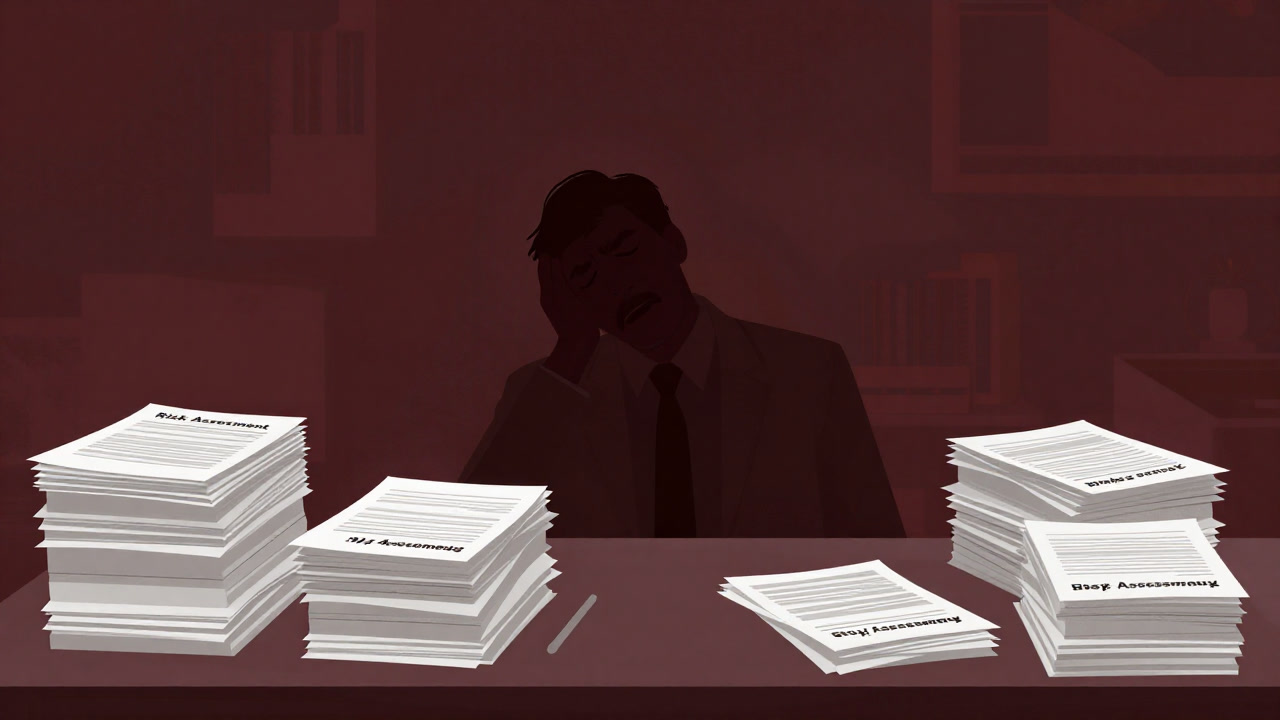
Risk assessment is the sacred ritual of assigning meaning to a string of calculated numbers in hopes of averting nightmares yet to come. Superficially it offers comfort, but when scrutinized, it reveals itself as a ghost of hollow figures. Depending on whether one errs toward optimism or pessimism, infinite variants of proposed countermeasures emerge, most of which slumber unimplemented. Ultimately everyone cites it as a shield for avoiding responsibility, and the assessment itself vanishes into oblivion.
Definitions
- A device for generating excuses by quantifying the uncertainties of tomorrow.
- A corporate incantation performed to feign a sense of security.
- The offspring of meeting minutes, where even promised measures fall into oblivion.
- A prebooked scapegoat service for shifting blame when things go awry.
- A breeding ground for sophistry, weaving ambiguous justifications through strings of numbers.
- A stage prop that squander resources on cost and time yet solves nothing.
- A fantasy castle built upon opaque assumptions.
- A paradoxical process that creates risk by overzealous safety measures.
- The mastermind that conceals the true cause when outcomes disappoint.
- A ritual that prophesies future calamities while neglecting the arithmetic of their likelihood.
Examples
- “The risk assessment results? Take a look—technically the world could end, according to these figures.”
- “Countermeasures based on this number? Oh, they’re quietly dying somewhere in a folder.”
- “As I always say, risk assessment is nothing more than a time-wasting tool for meetings.”
- “This chart? Just an art piece designed to sow panic.”
- “A risk assessment report? It’s an internal legend nobody ever reads.”
- “High risk? Let’s mitigate it… five years later, still on the to-do list.”
- “This model is perfect… insisting so is the very essence of risk assessment.”
- “What if predictions are wrong? Official policy: pretend you never noticed.”
- “They call risk assessment the corporate oracle? More like a numerical fortune-teller.”
- “Safety first? The first step is always drafting the risk assessment document.”
Narratives
- The stack of risk assessment documents in the meeting room resembled ancient manuscripts posing as warnings from the future.
- The project manager distributed the figures without grasping their weight, continuing the charade.
- The more pessimistic the tone of the results, the more bloated the countermeasures became—and the less anyone acted on them.
- The wording of the assessment was perpetually updated, yet no real-world action ever followed.
- The evaluation meeting was charged with fervor, only to end without resonating in any heart.
- Each time predictions betrayed expectations, the process plunged into a cycle of self-justification.
- The occasional optimistic scenario was an entertainment that offered daydreams rather than execution.
- The whiteboard covered in formulas was revered like a modern grimoire.
- By the time the assessment phase concluded, the initial risks were long forgotten as new crises quietly sprouted.
- In the end, nobody even asked what, if anything, this assessment had actually protected.
Related Terms
Aliases
- Excuse Generator
- Anxiety Investment
- Meeting Punching Bag
- Numeric Bondage
- King of What-Ifs
- Invisible Shield
- Future Fortuneteller
- Fictional Garden
- Responsibility Dodger
- Endless Paperwork
Synonyms
- Risk Game
- Safety Performance
- Tower of Hypotheses
- Powerless Prophecy
- Labyrinth of Calculations
- Prologue Ritual
- Mitigation Horizon
- Uncertainty Inc.
- Assurance Masquerade
- Festival of Numbers
Use the share button below if you liked it.
It makes me smile, when I see it.