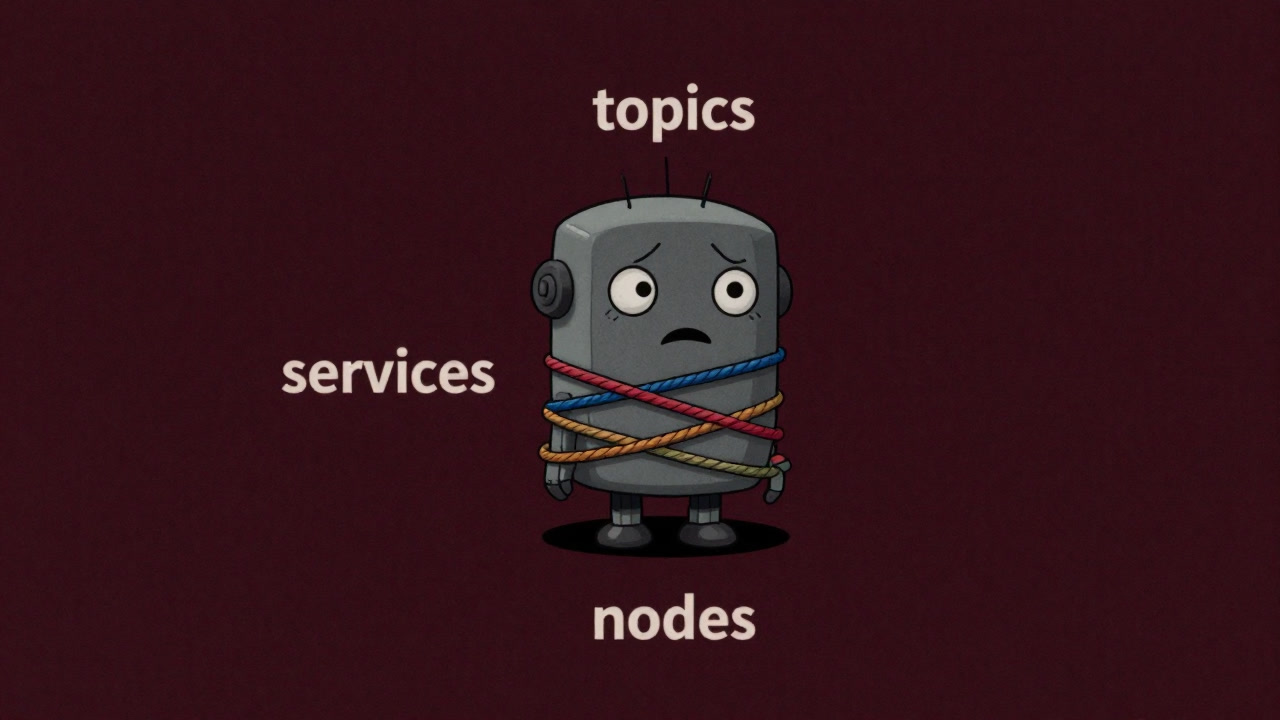
Description
ROS is touted as the nervous system of robots but often resembles an altar of broken workflows in a labyrinth of dependencies. Under the banner of open source, it bestows the baptism of installation failures upon unsuspecting engineers. A single launch command brings a fleeting sense of triumph, immediately drowned by a deluge of logs as a welcoming ritual. Visualization tools cast a glimmer of hope, yet act as illusionists concealing the screams of hidden errors.
Definitions
- Touted as the nervous system of robots, yet its wiring becomes a nightmarish maze of software threads.
- Promised high flexibility, but its dependencies cling infinitely like a parasitic curse.
- Marketed as educational, yet it teaches despair from the very first tutorial.
- A resource vampire that spawns endless little ‘nodes’ on your system.
- A trial by fire ensuring only those who survive its build-and-launch ritual comprehend its master-servant relationship.
- Dreams of distributed harmony, but manages to sow chaos even on a single machine.
- Preaches the gospel of message passing while delivering debugging hell.
- Billed as open source, yet its community’s chaos defies any attempt at control.
- Promises lifecycle management and auto-restart, but betrays you at shutdown like a demon.
- Claims to unify sensors and actuators under one roof, yet forces per-device configuration like a trickster.
Examples
- “ROS won’t start? Maybe try chanting the Master URI backwards to appease it.”
- “No messages on the topic? Someone probably forgot to launch roscore again.”
- “A launch file is a magic circle: summon your dependencies, invite disaster.”
- “Heard screaming from catkin_make? That silence is your warning siren.”
- “Gazebo? It’s a dream peddler selling illusions.”
- “Calling a service? Don’t forget to celebrate the festival of HTTP 500.”
- “Changing parameters via rosparam? That is a ritual of digital witchcraft.”
- “Using nodelets for speed? Bugs will arrive at twice the pace.”
- “TF frames? You’ll lose your own coordinates in an infinite loop.”
- “ROS2? A reboot that proudly waves the same old wounds under a new name.”
- “Installing dependencies? You need a warehouse keeper to navigate that map.”
- “Enjoying rviz visuals? Meanwhile, errors cry out behind the scenes.”
- “Published a msg? That’s the lonely voice no one subscribes to.”
- “Hammering roslaunch? That sound is the death knell of an engineer’s sleep.”
- “Spaces in topic names? The genesis of self-inflicted annihilation.”
- “Initializing a workspace? Etch your past failures into eternity.”
- “Playing rosbag to view the past? All you’ll recall is trouble.”
- “Debug logs? They record innumerable digital confessions.”
- “Restarting over and over? ROS demands rebirth like a living being.”
- “ROS tutorials? A hallucinogen that makes reality feel like a distant dream.”
Narratives
- [Ritual] In the cathedral of ROS, code receives divine oracles while dependencies resurrect as monstrous fiends.
- Engineers believe launching roscore lights a beacon of peace, though it’s but an illusion bought for a moment.
- Inter-node communication is poetically lauded, yet behind the scenes logs overflow infinitely, eroding sanity.
- Simulation in Gazebo reflects ideals like a mirror, but only masks real-world debugging hell with a benevolent veneer.
- catkin_make build times act as torture timers, testing both patience and optimism.
- A clean workspace build forces a harrowing dialogue with past failures.
- ROS parameters are treated like spells, where a single misplaced character can unleash catastrophic collapse.
- Service calls, promised as reliable feature invocations, often lure developers into an API labyrinth of doom.
- Coordinate transforms via tf are heralded as orchestral harmony but frequently spawn unpredictable chaos.
- Migration to ROS2 proclaims a new era, yet the grudges of the old version still cling to the systems.
- roslaunch is the priestly grimoire—mispronounce its incantations and calamity ensues.
- Replaying rosbag is billed as a journey to the past, but you mainly revisit logs of failure and stunned defeat.
- Controllers meant to move robotic limbs become mere spectators under ROS’s abstraction.
- Visualization tools dancing on dashboards are illusionists masking the chaos of the field.
- A build swallowed by dependencies becomes an odyssey without end.
- The myriad variations spawned by rosparam settings mirror a researcher’s descent into madness.
- The gap between simulation and hardware is a cold shower that shatters ROS’s godlike promises.
- Editing launch files can be described as an act of stripping reason from any developer.
- When multiple nodes spawn, one feels trapped in a delusion of electronic cells proliferating at will.
- ROS traverses the boundary between dream and reality, bestowing developers with perpetual unease.
Related Terms
Aliases
- Topic Bard
- Dependency Hellguide
- Node Summoner
- Launch Zealot
- Build Inquisitor
- Param Priest
- Rviz Illusionist
- Debug Casualty
- roscore Gatekeeper
- Gazebo Dream Merchant
- Msg Evangelist
- Service Executor
- TF Labyrinth Keeper
- Rosbag Amnesiac
- Catkin_make Victim
- Abstraction Oracle
- Simulation Prisoner
- Master Worshipper
- Hardware Betrayer
- Workspace Warden
Synonyms
- Message Cleric
- Community Fiend
- Build Beast
- Chaos Generator
- Workflow Wanderer
- API Trap
- Communication Labyrinth
- Error Rain Shaman
- Log Vampire
- Abstraction Void
- Dependency Curse
- Tool Phantom
- vi Martyr
- YAML Jailkeeper
- Python Script Drinker
- C++ Demon
- Docker Ghost
- Traversal Fiend
- System Pet
- Module Wraith
Use the share button below if you liked it.
It makes me smile, when I see it.