Description
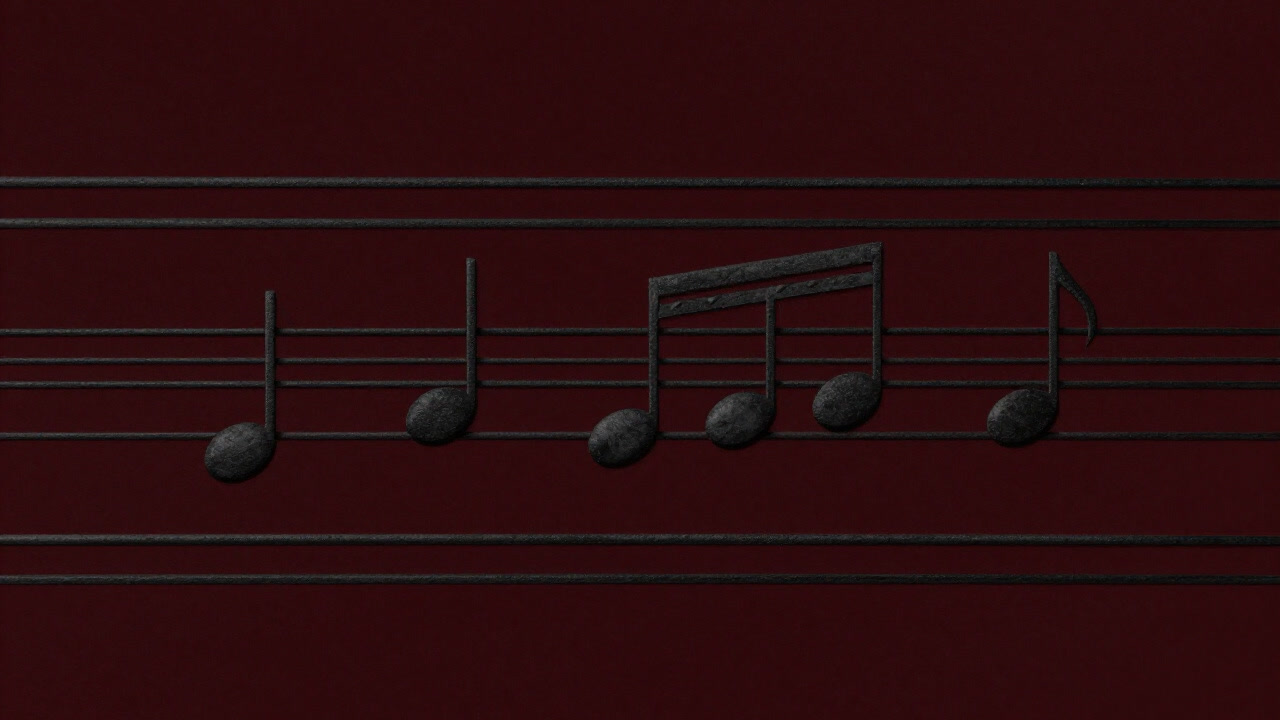
The staff is the lineup notes must join to earn musical citizenship. Five parallel lines, ordered by the composer’s decree, enforce a hierarchical order of pitch. Notes either sit ignored or are crowned with circles, elevated to imperial status. Without the staff, music is nothing more than chaotic doodles.
Definitions
- A checkpoint of the musical world where notes must walk precisely or be denied harmony.
- A momentary judge that instantly assigns social class to notes by the composer’s whim.
- Five parallel lines standing as a silent army, reigning as a shield against chaos.
- Merely serving as a platform for notes, without which remains only a pile of round scribbles.
- A covert weapon upholding the composer’s dictatorship under the guise of music theory.
- A secret notation board reserved only for those musicians who can read and write it.
- A glass case that transforms space and time into visible form, imprisoning the composer’s thoughts.
- A guidepost to melody that simultaneously bars those who favor pure rhythm from passage.
- Lines pasted onto the page that sometimes shackle art and bind creative freedom.
- A troupe of dancing notes kept under stricter rules than one might imagine on the staff lines.
Examples
- “The staff? Without those five lines, music would collapse into chaos.”
- “If you can dance with the staff, maybe the world would be a more peaceful place.”
- “Complaints about inequality on the staff lines? Well, it’s music after all.”
- “Writing the staff is easy, but if the performer can’t read it, what’s the point?”
- “Composers treat the staff as a canvas and notes as mere paint.”
- “You’re saying this piece is an explosion of passion that can’t be contained by the staff?”
- “Tear down the staff, you spark a revolution—just nobody will listen then.”
- “My head hurts just looking at the staff—you’re a true musical masochist.”
- “Rests on the staff are silent protests of the musical world, I believe.”
- “Mess up even one line on the staff, and the conductor’s blood pressure soars.”
- “Never break the promises written on the staff; exceptions are forbidden.”
- “A beginner approaching the staff is like a child on a slippery slide.”
- “A messy staff score is proof of the composer’s inner turmoil.”
- “Imagine measuring the amount of passion crammed into a staff.”
- “The staff is just a framework; perhaps true art lives outside the lines.”
- “If you can’t read the staff, please don’t perform. It’s a public nuisance.”
- “While drawing the staff, I realized I’m just a prisoner of lines.”
- “Think music flows just by tracing the staff? Big mistake.”
- “Composers hiding behind the staff, crying behind the lines.”
- “Mastering the staff steps doesn’t make you world-class.”
Narratives
- On the music stand, the staff stood like a strict judge, overseeing every note’s movement.
- Composers inscribe their desires onto the staff, forcing performers into submission.
- In late-night studios, staring at a blank staff resembles the devotion of a monk in training.
- Melodies written on the staff seemed to leap off the page, seeking freedom beyond its lines.
- A messy staff score is a liar’s decoration, hiding the composer’s inner unrest.
- Unfolding the sheet reveals parallel lines racing through the mind like railway tracks.
- Improvisation without a staff is a forbidden trick reserved for only the most eccentric.
- Notes aligned on the staff stand like tiny citizens organized to maintain order.
- Empty spaces on the staff conceal both laziness and vanity of the composer.
- Laying down staves for each composition is like designing an endless labyrinth for oneself.
- Pieces bound by the staff often become dull marches confined to a rigid mold.
- There are nights spent erasing staves to question the very nature of art.
- The staff cools music’s warmth, enveloping it in the icy grip of theory.
- Composers often treat the staff as a canvas and notes as brushstrokes to paint their freedom.
- Bar lines on the staff act as scrutinizing eyes, controlling even a musician’s breath.
- Place a note on the wrong line and errors spread across the score like a contagion.
- The staff is a transparent tome listing all invisible rules of music.
- Nobody knows the resolve required to draw staves on paper with pencil alone.
- The rests hiding within the staff give or take life from the composition.
- As the concert begins, the staff becomes a silent conductor, commanding the orchestra.
Related Terms
Aliases
- Note Visa
- Melody Sidewalk
- Musical Checkpoint
- Silent Prison
- Temple of Staves
- Sound Bus Stop
- Rhythm Aristocracy
- Note Boot Camp
- Cell Bars
- Melody Highway
- Music Grid
- Score Fence
- Tuning Embassy
- Theory Rampart
- Creativity Auditor
- Statue Graveyard
- Note Reserve
- Poetic Telepost
- Melody Litmus Test
- Dissonance Breakwater
Synonyms
- Note Maze
- Melody Cage
- Harmony Shackle
- Sound Frame
- Fife Line
- Melody Groove
- Theory Stroke
- Tone District
- Do-Re-Mi Lane
- Pitch Spire
- Clef Fetters
- Score Track
- Music Grid
- Sound Barrier
- Spatial Hierarchy
- Rhythm Dam
- Tuning Gate
- Score Outline
- Melody Trace
- Meter Cage
Use the share button below if you liked it.
It makes me smile, when I see it.