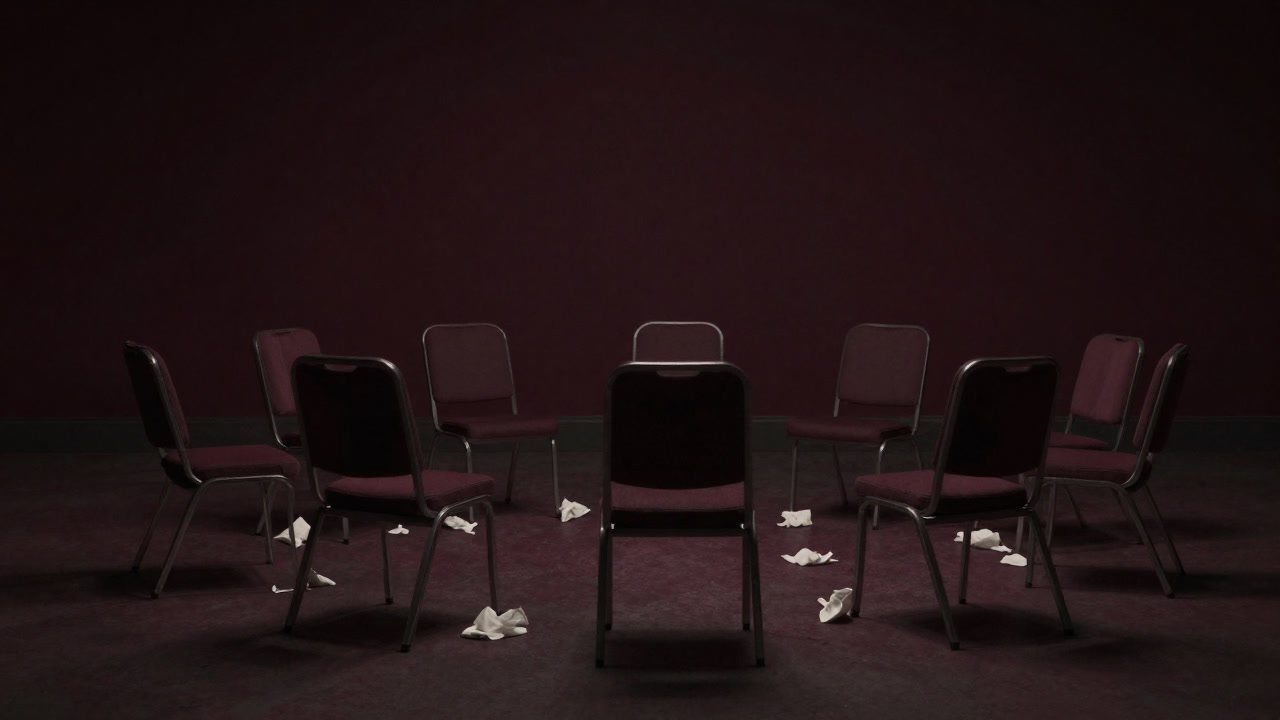
Description
A support group is a gathering masquerading as a forum for mutual aid, where self-soothing takes precedence over actual assistance. Participants derive self-validation from sharing woe, as if misery multiplied equates reassurance. Sessions revolve around a ritual of complaints and pep talks, valuing the performance of empathy over concrete solutions. It operates more as a social ceremony than a practical workshop, and few dare question its raison d’être.
Definitions
- A social ritual that B.Y.O. (Bring Your Own Woe), amplifying shared anxieties to compete for reassurance.
- A theater of suffering where one evaluates personal misery against the backdrop of others’ pain.
- An assembly justifying inaction through the perpetual recycling of complaints and empathetic nods.
- A communication sport that stages solidarity in lieu of substantive problem solving.
- A semi-compulsory routine masquerading as voluntary participation.
- A selfish apparatus that inflates self-esteem the more one vocalizes woes.
- A toxin of comfort that refuses silence, ensuring someone always lodges a grievance.
- A live show of hollow insights where advice circulates without substance.
- An infinite loop where counselors require counseling themselves.
- A fact-concealing mechanism where the motive is consuming empathy, not mutual aid.
Examples
- “How’s it going?” “Well, I thought I could share anything here… It turned out to be just a complaint fest.”
- “They said you’d get geared up with positivity, but we ended depressed as a group.”
- “Love this support group! Gets you that cozy, mutual-destruction vibe.”
- “Did you hear her? More self-narratives, fewer solutions.”
- “No one knows if they just want to cry or actually want help in this crowd.”
- “Next session, let’s share success stories… Oh, I guess no actual examples needed?”
- “The warmth of a group is really the heat from everyone’s misery, right?”
- “Encouragement? Just a corporate courtesy among sufferers.”
- “I come here and forget why I even showed up in the first place.”
- “Once it breaks up, the hunt for new excuses begins.”
- “I feel my problems shrink… or maybe that’s just the placebo effect of communal complaining.”
- “No progress again… well, at least it’s comforting in a way.”
- “If you spent session time doing something, you’d actually help yourself… but nobody says that.”
- “Advice from others? It’s always gone before you get home.”
- “They call it mutual aid, but it’s just a self-satisfaction club.”
- “It’s like group hypnosis: share your fears, and they multiply.”
- “This feels like a social media comment section in real life.”
- “Funny how with so many participants, no one ever reports actual progress.”
- “There’s no exit… Is there an exit strategy meeting?”
- “Support groups are just excuse repositories for the unsupported.”
Narratives
- One evening, the support group resembled an exhibition where everyone cataloged each other’s sorrows and shelved their own complaints.
- The group leader scatters words of encouragement but everyone knows follow-up ends when the meeting does.
- Participants’ eyes gleam with hope, yet the reality is a silent dance party where no one extends a helping hand.
- True solutions lie outside, but attendees are shackled within the prison of group sessions.
- Simply meeting regularly is a psychological trick that makes problems feel like they’ve vanished.
- The most dangerous sign of co-dependency is the silence no one dares to break.
- Free-form complaint time is akin to a ritual of shared self-harm.
- Seeking an exit becomes taboo, ensuring an eternal loop.
- Support in name only, with hidden power struggles erupting among participants.
- The moment smartphones appear, everyone falls ill to the urge to post their agony on social media.
- Each chant of ‘stay positive’ amplifies the pressure of silence.
- Shared stories decay instantly, becoming a real-time rumination machine that changes nothing.
- They call it counseling but it’s really a lecture hall echoing ones own amplified voice.
- Problems are raised weekly, but solutions never make the agenda.
- The leader’s smile is more that of a stage director than a healer.
- Before one person’s tears dry, a new tragedy takes the stage on a rotating schedule.
- The secret meetings in hallway corners are nothing more than rumor salons.
- Words of support from the outside never arrive, recycled endlessly in a self-contained echo chamber.
- Without a therapist in sight, the venue becomes a paradise for co-dependents rather than professionals.
- What remains at the end is not pleas for help but the comfort of shared complicity.
Related Terms
Aliases
- Grievance Gala
- Woe Exchange
- Tear Shield
- Co-dependency Pandemic
- Misery Loves Company Club
- Self-Soothing Studio
- Output Hell
- Emotional Sport
- Unhappiness Contest
- Empathy Drug
- Comfort Machine
- Tragedy Catalog
- Emotional Circus
- Complaint Factory
- Rehash Live
- Sympathy Maker
- Reassurance Scam
- Lament Orchestra
- Sentiment Salon
- Support Cult
Synonyms
- Co-dependency Club
- Complaint Club
- Tear Exchange
- Sorrows Meeting
- Therapy Pretend
- Void Circle
- Error Discussion
- Self-Pity Guild
- Stranger Alone Club
- Echo Sympathy
- Support Variety Show
- Sorrow Roundtable
- Whine Symposium
- Emotion Bazaar
- Comfort Trip
- Anxiety Sharing
- Doldrums Fest
- Lament Cult
- Comfort Workshop
- Pity Market
Use the share button below if you liked it.
It makes me smile, when I see it.