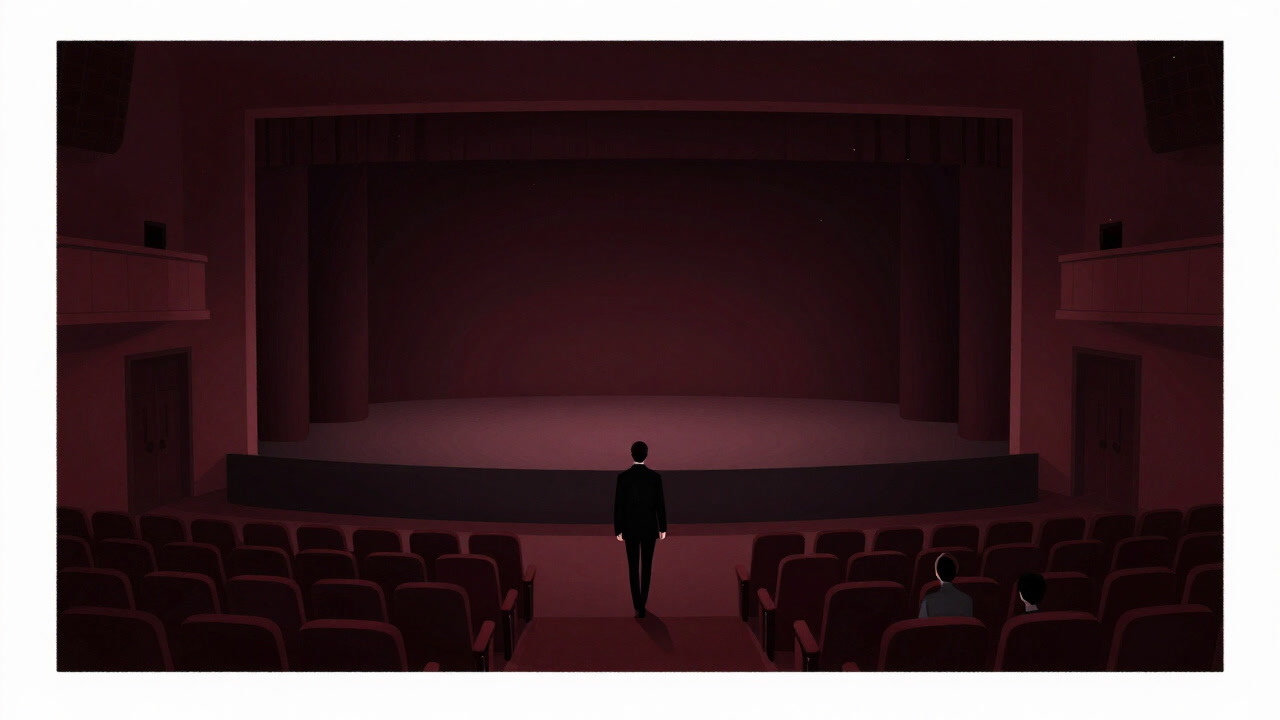
Description
A thrust stage is a platform jutting into the audience’s territory. By extending performance space on three sides, it erases the boundary between actor and spectator, as if the play itself demands audience complicity. Forsaking the safety of a proscenium arch, the performer invades the crowd’s personal sphere. Under the guise of intimacy, it harbors a quiet terror: spectators forced into the action they thought they merely observed. Purportedly celebrating openness and participation, it actually entangles stage managers and audience alike in a device of unruly chaos.
Definitions
- A stage configuration that brings performers dangerously close to audience personal space to simulate participation.
- A theatrical device that forsakes the protective proscenium arch to incite illusions of direct physical contact.
- A chaos generator that, under the guise of openness, deprives both actors and viewers of control.
- A visual trap capturing spectators’ gaze from three sides, forcing them to share the performer’s intent.
- An invention that terrifies stage managers by exponentially increasing the difficulty of stage control in all directions.
- A magic that abolishes the “safe zone” of theater and turns audience members into unwitting participants.
- A tyrannical stage design that, in the name of participatory theater, robs spectators of any escape.
- A universal tool that shatters traditional stage boundaries to maximize theatrical unpredictability.
- A device that transmits actors’ sweat and voices directly to the crowd, escalating the intensity of performance.
- A stage shape that blurs physical boundaries, even allowing actors to sit on audience members’ laps.
Examples
- “This thrust stage is aiming for my lap, I swear…”
- “I booked a seat, not a rainstorm of actor sweat!”
- “You know if a scene fails, the actor might barrel into the audience?”
- “That performer just whispered lines right next to me… like a betrayal!”
- “Stage manager, don’t retract the lighting now! We’re all panicking!”
- “Hey, quit using my bag as a ladder… is this really audience seating?”
- “They called it participatory theater, but now it seems the audience is the star.”
- “Front row? More like front line—I think my blood pressure is higher than the play.”
- “The feeling that the stage is chasing you when you turn around is insane.”
- “Is this a play or a roller coaster ride?”
- “I never know when to applaud whenever someone paces by me!”
- “I didn’t sign up for a runway that surrounds me on all sides.”
- “This seat offers theatrical immersion and a side of terror.”
- “Thanks to the thrust stage, holding my bladder through an hour-long show is impossible.”
- “My heart can’t handle being under the gaze of an actor full-on.”
- “Is stepping off the stage’s edge an immediate dismissal now?”
- “I tried to hide my presence, but the actor sensed me. What is life?”
- “The guy next to me got a program smacked on his leg… victim of theater.”
- “Maybe next week I’ll request an even more thrilling seat.”
- “I need a thrust exit. Where do I go home?”
Narratives
- Audiences are lured onto the jutting platform like prey in a theatrical trap.
- When the light pulls back, and the actor’s shadow falls just beside you, your spine chills.
- No safe zone exists here; spectators are forever immersed in the drama’s vortex.
- The terror of being watched from three directions transforms entertainment into a trial.
- Every line slams into the eardrums, sending heartbeats skyward.
- An actor perched on the stage’s edge banters upon spotting a spectator’s smartphone.
- Directors feed actors instructions to weave between seats, reading the crowd’s reactions.
- A prop flung by mistake becomes an unexpected casualty, striking a spectator’s bag.
- Parts of the audience seating morph into set pieces themselves.
- Audience coughs between lines add a gritty realism to the performance.
- As the story unfolds, spectators oscillate between seeing actors’ backs and full-on stares.
- Post-show, someone sprains an ankle on a rogue prop, etching the memory deeper.
- The thrust stage’s architect aimed to trap spectators in a three-dimensional labyrinth.
- A chilling draft from the stage’s vents amplifies the tension in the seats.
- Even the silence before the curtain rises brims with ominous anticipation.
- Every swipe of a phone prompts instant, improvised reactions from the performers.
- This stage is an aberrant space that physically erodes psychological distance.
- The curtain call’s applause reaches out for help from the platform.
- As actors retreat, they reclaim silent authority from the audience, whisking it away.
- Patrons leave not only with a ticket stub but trauma beyond the price of admission.
- Until the last person exits, the stage continues to gaze upon its three-sided spectators.
Related Terms
Aliases
- Audience Erosion Device
- Stage Spear
- Three-Side Watchtower
- Close-Contact Platform
- Performer Landing Pad
- Gaze Trap
- Chaos Generator Stage
- Distance Destroyer
- Audience Dive Machine
- Forbidden Protrusion
- Stage Invasion Weapon
- Immersion Engine
- Boundary Breacher
- Theatrical Abductor
- Inescapable Trap
- 3D Maze Stage
- Sight Constraint Device
- No-Escape Stage
- Theater Survival Zone
- Mandatory Participation Rig
Synonyms
- Projection Plinth
- Three-Quarter Stage
- Audience Entanglement Rig
- Immersion Forcer Stage
- Frontline Platform
- Surrounding Ramp
- Theater Pocked Stage
- Gaze Uprising
- Pressure Podium
- Adjacent Rostra
- Forward Protrusion Stage
- Forced Audience Rig
- Tripod Advance Stage
- Audience Preview Machine
- Theater Erosion Stand
- No-Blindspot Stage
- Intimacy Cling Stand
- Theatrical Boost
- Audience Guidance Pedestal
- Forced Dialogue Stage
Use the share button below if you liked it.
It makes me smile, when I see it.